Technology
Entrepreneurship.
This guide teaches the course in simple English — built to help you understand, not memorize. Use the two buttons above: 📚 Full Course shows every week (1–12). 🎯 Final Exam shows only the subjects your professor said are on the final, plus a 5-hour plan and a mock exam. If you understand the reasoning here, you can solve any exam question they give you.
Your Final Exam — Exactly What To Study
The 7 Subjects — And Where To Find Them Here
Your professor listed 7 subjects. In this guide they live inside 4 week-sections. Here is the exact map:
| The subject on your exam | Study it here |
|---|---|
| 1 · Prototyping & User Experience (UX) | Week 7 |
| 2 · Go-to-Market Strategy | Weeks 8–9 (first half) |
| 3 · Startup Financials & Metrics | Weeks 8–9 (second half — the calculations) |
| 4 · Funding & Investment | Weeks 10–11 (first half) |
| 5 · Building & Managing a Team | Weeks 10–11 (second half) |
| 6 · The Art of the Pitch | Week 12 |
| 7 · Storytelling | Week 12 (story parts) |
Your 5-Hour Study Plan
You can get ready in 5 hours even if you start from zero. Take a 5-minute break each hour. After each part, try the "Can You Explain These?" questions inside that week — if you can answer in your own words, you understand it.
How To Answer Exam Questions (Very Important)
1. Name the idea — "This is the LTV:CAC rule" / "This is the 3-act story."
2. Show your steps — for math, write each line: the formula, then the numbers, then the answer.
3. Explain why — one sentence on what the result means.
4. Give a clear recommendation — "So the startup should…"
The exam rewards understanding, not memory. A right number with no reasoning is weak; a clear explanation is what earns the marks.
How To Use This Guide
How this guide works
- Each week is one big topic. Read them in order. Each week builds on the one before it.
- Hard words look like this. The simple meaning is written right next to them.
- Boxes in blue are key ideas. Boxes in red are warnings — common mistakes to avoid.
- At the end there are practice questions in the final exam style — real company data and situations to solve. Try each one on paper first, then press "Reveal Answer" to compare.
The one big idea of the whole course
Your 8-Hour Study Plan
You can learn this whole course in 8 hours. Follow this plan. Take a 5-minute break every hour. After each week, try the "Can You Explain These?" questions — if you can answer in your own words, you truly understand it.
What Is Inside
- Week 1 — What Is Technology Entrepreneurship?Basics
- Week 2 — Finding Good IdeasIdeas
- Week 3 — The Business Model CanvasPlanning
- Week 4 — Talking To CustomersTesting
- Week 5 — The Market And Other CompaniesMarket
- Week 6 — Building The First Product (MVP)Product
- Week 7 — Prototypes And Easy-To-Use DesignDesign
- Weeks 8–9 — Selling And MoneySales · Money
- Weeks 10–11 — Getting Money And Building A TeamFunding · Team
- Week 12 — How To PitchPitching
- The Ideas Behind The CourseBig Ideas
- Practice: Business Model Canvas QuestionsPractice
- Quick Review (All Key Points)Review
- Final Exam Practice — 26 Scenario QuestionsExam Prep
What Is Technology Entrepreneurship?
Let's start simple. Entrepreneurship means starting and running your own business. Technology entrepreneurship means doing it with tech — like apps, websites, or software.
1.1 What Smart People Say About It
Three famous thinkers explained what entrepreneurship really is. You should know their names and their main idea.
1.2 Two Myths (Things People Get Wrong)
| People Think... | But Really... |
|---|---|
| "You can only be a founder by starting a company." | You can also do it inside a big company. This is called intrapreneurship (acting like a founder while working for someone else). |
| "Founders are born that way. You can't learn it." | Wrong. It is a skill you can learn. Top schools like Harvard and MIT have proven this. You learn by practice. |
1.3 How A Founder Thinks
Researchers at MIT found that good founders share three things. Remember these three:
- They don't give up (the word for this is resilience — getting back up after you fail).
- They do a lot with very little (the word is resourcefulness — being clever with few resources).
- They look for answers, not problems (they focus on fixing things).
The Five Habits Of A Founder's Mind
| Habit | What It Means | The Question They Ask |
|---|---|---|
| See chances | They see a problem and think "I can fix this and make money." | "What annoys people that I could fix?" |
| Take smart risks | They test an idea cheaply before spending a lot. | "How can I check this for little money?" |
| Bounce back | They learn from failing and try again. | "What did this failure teach me?" |
| Act fast | They move from idea to doing quickly. | "What can I make this week?" |
| Be clever with little | They make their own luck instead of waiting. | "Who can help me do this?" |
"If you are not embarrassed by the first version of your product, you launched too late."— Reid Hoffman, who started LinkedIn
This means: don't wait until your product is perfect. Show an early, simple version fast. You will learn more that way.
1.4 Why Coders Make Great Founders
Many huge tech companies were started by people who write code, not by business people. For example: Apple, Google, Facebook, Microsoft, and Amazon.
1.5 The Three Big Tools Of This Course
The whole course uses three main tools. You will learn each one deeply later. Here is a quick look.
Tool 1 — The Business Model Canvas (BMC)
This is a plan for your whole business on one page. It has 9 boxes. It is not a paper you write once and forget — you change it as you learn. (Full details in Week 3.)
Tool 2 — Lean Startup (Build, Measure, Learn)
This is like a science test for your business. You build a small version, you watch how people use it, and you learn. Then you decide: keep going, or change your plan.
Tool 3 — Customer Development (by Steve Blank)
This means: go out and talk to real people before you build. It has two parts — first you search for a good idea, then you grow the business.
| Part | Step | The Goal |
|---|---|---|
| SEARCH (find a good idea) | 1 · Customer Discovery | Find a real problem worth solving |
| 2 · Customer Validation | Check that people will pay for it | |
| GROW (make it bigger) | 3 · Customer Creation | Get many more customers |
| 4 · Company Building | Build a real, organised company |
"There are no facts inside your building. So get outside."— Steve Blank
This means: you can't learn the truth sitting at your desk guessing. You must go outside and talk to real people.
1.6 What Makes A Business "Scalable"?
A scalable business is one that can grow very big without costs growing at the same speed. It explains why software companies can grow so fast — worth really understanding.
- Scalable: money grows fast, but costs grow slowly. You do NOT need to hire one new person for every new customer. It can work in local AND global markets. (Example: software — write once, sell to millions.)
- Not scalable: money only grows when you hire more people. Each new customer needs more staff. (Example: a barber shop — more customers need more barbers.)
1. Why do 42% of startups fail?
Because nobody needed what they built. They made something no one wanted. This is the #1 reason startups die.
2. What does "get out of the building" mean?
Steve Blank's rule: you can't learn the truth sitting at your desk. Go outside and talk to real customers.
3. Are founders born or made?
Made. Entrepreneurship is a skill anyone can learn through practice — Harvard and MIT research proves it.
Finding Good Ideas
"Not every idea is a good chance. The skill is knowing the difference."— Main lesson of Week 2
An idea is just a thought. An opportunity (a real chance) is an idea that people need, that you can build, and that can make money. Most ideas are not opportunities. Your job is to find the ones that are.
2.1 Three Parts Of Spotting A Chance
Example: You notice many people work from home now, but their tools are still old and bad.
Example: People at home feel lonely and miss talking with their team.
Example: You build a small test to see if teams will pay for a tool that helps them feel together.
2.2 The Four Steps To Spot A Chance (EOR)
- Look around — Watch trends, news, and how people act. ("Read tech news. Watch how people travel.")
- Connect ideas — Join two unrelated things. ("What if we sold glasses by monthly payment, like Netflix?")
- Check it — Is the need real? Can you build it? Is there room for you? ("Is the market big enough?")
- Improve it — Make a small test version and get feedback. ("Build a simple web page to see if people want it.")
2.3 Three Ways To Find Chances
| Way | How It Works | Example |
|---|---|---|
| Problem first | Start with a problem that hurts a lot, happens often, and feels urgent. Find the "big pain," not a small one. | Canva: Design software was too hard and too costly for normal people. |
| Market change | Watch a big change in the world (new tech, new rules, new habits) and find the new needs it makes. | Uber: Smartphones with maps (GPS) made a new kind of taxi possible. |
| Copy a pattern | Take an idea that works in one field and use it in a new field. | Airbnb: "eBay, but for empty rooms" — letting people rent out their homes. |
2.4 Ways To Think Of Many Ideas (Brainstorming)
Brainstorming means thinking of many ideas fast, without judging them yet. Here are useful ways to do it.
2.5 The Best Rules For Brainstorming
- Many ideas, not perfect ideas. Make 100 ideas to find 5 good ones. The best ones often come last.
- No saying "that's bad." First make ideas, judge them later. No idea is "wrong" at this stage.
- Use a timer. A short time limit makes you work fast and free.
- Mix different people. Same kind of people make same kind of ideas. Mix coders, designers, and business people.
2.6 The Founder's Super Skill: Seeing Patterns
▸ AI + law jobs = software that checks contracts
▸ Old people + smart homes = home care tech for grandparents
▸ Working from home + caring about the planet = green travel for remote workers
"Don't just look at the dots. Look at the lines between them."
Example — Uber Saw Three Things Come Together
Uber did not invent cars or taxis. They saw that three changes happened at the same time, and together they made something new possible:
- New tech — Phones with maps (the iPhone came in 2007).
- New habit — People got used to saving their card in apps and trusting them.
- A real pain — Taxis were hard to find, often rude, and cash only.
2.7 Warning Signs: When An "Idea" Is Not A Real Chance
2.8 A Few More Thinking Tools
These are a few more ways of thinking about ideas. Each one is simple once you see the point behind it.
Painkiller vs. Vitamin
- Painkiller = a product that fixes an urgent, serious need. People MUST have it. (Example: an antibiotic — medicine that kills infection.)
- Vitamin = a product that is nice to have, but people can live without it. (Examples: video games, premium coffee, Netflix.)
- Build painkillers, not vitamins. People pay faster for painkillers.
Jobs-to-be-Done (by Clayton Christensen)
Market Pull vs. Technology Push
- Market pull (good) = the need already exists, and you build the fix. (Example: people hate long waits at clinics → you build a booking app. Or: working from home grows → people need home office furniture.)
- Technology push (risky) = you invent a technology first, then search for someone who needs it. (Example: a lab invents a new laser, then looks for a use.)
Six Thinking Hats (by Edward de Bono)
A team game for looking at an idea from six different sides. Each "hat" is one way of thinking. The point is to force yourself to see all sides, not just the one you already prefer:
| Hat | Way of thinking |
|---|---|
| White | Facts, data, information only. |
| Red | Feelings, emotions, gut sense. |
| Black | Care and risk — what could go wrong. (NOT hope!) |
| Yellow | Hope and good sides — the positive view. |
| Green | Creativity, new ideas, other options. |
| Blue | Control — managing the thinking process itself. |
The HiPPO Effect (A Bad Thing!)
The Paradox Of Ideas
Two Step-Orders — Understand Why They Flow This Way
You don't need to memorize these as lists. Notice that all three follow the same simple logic: start with the problem, not the solution. Once you see that, the order is obvious.
- The opportunity process: Find a real problem → think of ideas to solve it → check if those ideas can actually work → shape it into a business. (Problem first, business last — you can't build a fix before you know the problem.)
- The Lean Startup test process: Think of ideas → talk to customers to confirm the problem is real → design a prototype → test it. (Notice the customer check comes before building — that's the whole point.)
- Reverse brainstorming: Name the problem → flip it ("how could we make it WORSE?") → list bad ideas → flip each bad idea into a good fix. (A trick for when you're stuck — it's easier to see what's wrong than what's right.)
1. What turns an idea into a real chance (opportunity)?
Three things together: a real market need + you can build it + it can make money (value).
2. What is the golden rule of brainstorming?
No criticism while making ideas. First create many ideas freely, judge them later.
3. An antibiotic is a painkiller or a vitamin?
A painkiller — it fixes an urgent, serious need. Video games and Netflix are vitamins (nice to have).
The Business Model Canvas
"If we build it right, they will come" is the most dangerous belief in tech.
This means: just because you build a good product, it does NOT mean people will use it. You must plan for customers, money, and how to reach people too.
3.1 What The Canvas Looks Like
The Business Model Canvas (a one-page plan with 9 boxes) shows your whole business at a glance. The right side is about customers and value. The left side is about your work and tools. The bottom is about money.
3.2 The 9 Boxes — One By One
Box 1 — Customer Segments (Who You Help)
A segment is a group of customers. There are four common types:
| Type | What It Means | Example |
|---|---|---|
| Mass market | One big group with the same need. | Coca-Cola, TVs. |
| Niche market | One small, special group. | Software just for dentists. |
| Segmented | Groups with slightly different needs. | Banks (normal people vs. rich people vs. companies). |
| Multi-sided | Two groups that need each other. If one is missing, it fails. | Airbnb (hosts + guests). Credit cards (shops + card holders). |
Box 2 — Value Proposition (Your Promise)
This is the most important box. It answers: why should a customer pick you? There are six ways to give value:
Box 3 — Channels (How You Reach People)
A channel is the way you reach and serve customers. It has five stages:
- They hear about you (ads, search, word of mouth).
- They decide (reviews, free trials).
- They buy (website, app, sales person).
- You give them the product (download, delivery).
- You help them after (chat, help page).
Box 4 — Customer Relationships (How You Treat Customers)
This is how you talk to and keep your customers. Six common types:
| Type | What It Means | Example |
|---|---|---|
| Personal help | A real human helps the customer. | Shop staff, call centre. |
| Your own helper | One person is just for one big client. | A bank manager for a rich client. |
| Self-service | Customers help themselves. No human needed. | A petrol station, most apps. |
| Automatic + smart | The app knows the user and gives tips by itself. | Netflix saying "you may like this". |
| Communities | Users help each other. | Reddit, online forums. |
| Build together | Customers help make the product. | YouTube videos, Wikipedia. |
Box 5 — Revenue Streams (How You Make Money)
Revenue means the money that comes in. Six common ways:
| Way | What It Means | Example |
|---|---|---|
| Subscription | Customers pay every month. | Netflix, Spotify. |
| Pay as you use | Pay only for what you use. | Uber, electricity. |
| Freemium | Basic is free. Extra costs money. | Dropbox, LinkedIn. |
| License | Pay to use their idea or software. | Microsoft Office. |
| Ads | Other companies pay to reach your users. | Google, Facebook. |
| Marketplace | You take a small cut of each sale between users. | Airbnb, eBay. |
Box 6 — Key Resources (What You Need To Own)
These are the important things you need to run the business. Four kinds:
- Physical things — buildings, machines, trucks. (Example: Amazon's warehouses.)
- Idea things — your brand, your special code, customer lists. (Example: Google's search code.)
- People — the key humans, like your engineers.
- Money — cash to pay for things and hire people.
Box 7 — Key Activities (What You Do Each Day)
These are the most important jobs you must do. Three kinds:
- Making things — building the product. (Example: writing software.)
- Solving problems — finding answers for each customer. (Example: a law firm, a hospital.)
- Running a platform — keeping a website or network working. (Example: eBay, Uber.)
Box 8 — Key Partners (Companies That Help You)
A partner is another company that helps your business work. Four types:
- Friends (alliances) — partners who don't compete with you. (Spotify + Uber: music during your ride.)
- Frenemies (coopetition) — partners who also compete with you. (Samsung makes screens for Apple, but also competes with Apple.)
- New business together (joint venture) — two companies build something new. (Hulu was started by several TV companies.)
- Supplier deals — making sure you get what you need. (Tesla + Panasonic for batteries.)
Box 9 — Cost Structure (What You Spend)
- Fixed costs — same every month, no matter what. (Salaries, rent.) This is your burn rate (how fast you spend money).
- Variable costs — go up when you sell more. (Server costs, payment fees.)
- Economy of scale — when bigger means cheaper per item. (Software: write once, sell to millions.)
3.3 The Value Proposition Canvas (A Closer Look)
When you zoom into Box 1 (customers) and Box 2 (your promise), you get a smaller tool: the Value Proposition Canvas. It has two halves. One half is about the customer. The other half is about your product.
The Customer Half (3 parts)
"Cut the grass."
"Look good to neighbours."
"Feel like a good homeowner."
"The machine is too heavy."
"It takes too long."
"It's too loud."
"A perfect green lawn."
"More free time."
"A quiet machine."
The Product Half (3 parts)
- Products & services — the things you make.
- Pain relievers — how you remove the customer's pain. (Think: a painkiller pill.)
- Gain creators — how you give them the good results they want. (Think: the nice surprise.)
3.4 The Three Levels Of "Fit"
Fit means your product matches what people want. There are three levels:
| Level | What It Means | Where |
|---|---|---|
| 1 · Problem-Solution Fit | You found a real problem and made a plan to fix it. | "On paper" |
| 2 · Product-Market Fit | People actually use and love your product. | "In the market" |
| 3 · Business Model Fit | You can make money from it and grow. | "In the bank" |
3.5 The Golden Thread (The Whole Logic In One Line)
Think of your startup like a car:
The driver = the customer. Without them, the car goes nowhere.
The engine = your product. It turns needs into movement.
The body = the rest of the business (how you reach people, your costs, your money).
3.6 Example — Spotify (A Multi-Sided Business)
Spotify needs two groups, plus itself in the middle:
| Users (mass market) | Promise: "Music for everyone." They pay with money (subscription) or with their attention (ads). |
| Music owners (partners) | Big music companies (Sony, Universal). They get paid when their songs play. |
| Spotify (the platform) | Its main job: run the app and pay the music owners. Money in = subscriptions + ads. Money out = payments to music owners + server costs. |
3.7 Ways To Group Customers (Segmentation)
Segmentation means cutting the market into groups of similar customers. Exams ask about these types:
| Type | You group people by... | Example |
|---|---|---|
| Demographic | Age, gender, income, job. | "Students aged 18–24." |
| Geographic | Where they live. | "People in Istanbul." |
| Psychographic | Personality, values, lifestyle. | "People who care about the planet." |
| Behavioral | What they do and buy. | "People who shop online weekly." |
| Technographic | What tech they use. | "Shops using Shopify." |
| Needs-based | The problem they need fixed. | "People who need fast invoicing." |
3.8 Four Canvas Mistakes (The Quiz Asks These)
| Mistake | What it means |
|---|---|
| The "Everyone" Trap | Saying "everyone is my customer." You target everyone = you reach no one. (Example: Emma's fitness app for "anyone with a smartphone" got zero downloads.) |
| The Profit Blindspot | Never checking if money coming in is bigger than money going out. |
| The Broken Chain | The boxes don't connect logically. (Example: a free app sold in physical shops.) |
| The "Done" Delusion | Thinking the Canvas is finished. It is never finished — you update it every time you learn. |
1. Name the 9 boxes of the Canvas.
Customers · Value Proposition · Channels · Customer Relationships · Revenue · Key Resources · Key Activities · Key Partners · Costs. ("Competitive Analysis" is NOT one of them — trick answer!)
2. Airbnb needs hosts AND guests. What segment type is that?
Multi-sided market. Two groups that need each other — if one is missing, the business fails.
3. Samsung makes screens for Apple but also competes with Apple. What partnership type?
Coopetition (partners who are also competitors). Spotify + Uber = strategic alliance. Hulu = joint venture. Tesla + Panasonic = buyer-supplier.
Talking To Customers
4.1 Lean Startup — Build, Measure, Learn
Your startup exists to learn how to build a business that lasts. You do this in a loop, again and again:
4.2 Two Big Steps: Discovery vs. Validation
This is very important. There are two different jobs, and they ask different questions.
| Question | Customer Discovery | Customer Validation |
|---|---|---|
| Main question | "Is this a real problem?" | "Will people pay for my fix?" |
| What you do | Talk, watch, listen | Try to sell it, take pre-orders |
| What you get | Problem-Solution Fit | Product-Market Fit |
| Bad result | "Nobody really cares." | "They care, but won't pay." |
| You learn | Who, what, why | How much, how often |
| If it fails | Change the problem or the group | Change the fix or the price |
4.3 The Mom Test (How To Ask Good Questions)
Here is the problem: if you ask your mom "Is my idea good?" she will say yes — because she loves you. The Mom Test is a way to ask questions so good that even your mom can't lie to you.
The Three Rules
- Talk about their life, not your idea.
- Ask about the past, not the future. ("What did you do last week?" not "Would you buy this?")
- Talk less. Listen more.
4.4 Three Bad Answers (And How To Fix Them)
| Bad answer | They say... | Why it's useless | What to do |
|---|---|---|---|
| Compliments | "Great idea! I love it." | It means nothing. They are just being kind. | Dig deeper: "What would change in your day if you had this?" |
| Vague talk | "I usually do this all the time." | Too general. People are bad at guessing about themselves. | Get exact: "When was the last time? Walk me through it." |
| Feature wishes | "You should add this button!" | They are guessing, not telling you their real pain. | Find the why: "What problem would that button fix for you?" |
4.5 How Many People Should You Talk To?
You have talked to enough people when you can guess what the next person will say before they say it.
| Type of customer | How many | Why |
|---|---|---|
| Businesses (B2B) | 10–20 | Businesses act in similar, organised ways. |
| Normal people (B2C) | 30–50 | People are different and harder to predict. |
4.6 Your First Customers Are Special (Earlyvangelists)
An earlyvangelist is a special early customer. They buy your product even when it is not finished, because they need it so badly. They believe in your idea.
How To Spot Them — 5 Signs
- They have the problem.
- They know they have the problem.
- They are actively looking for a fix.
- They built their own messy fix already (a "hack").
- They have money to spend on it.
Warning: Don't mix up "they like it" with "they will pay." Only true earlyvangelists do both.
4.7 The Pivot (Changing Your Plan)
93% of successful startups ended up with a different plan than they started with. So the question is not "will I change my plan?" It is "when, and how smartly?"
4.8 Famous Cheap Tests (MVPs)
4.9 The Point Of Week 4 — In Plain Words
- Building something nobody wants is the #1 reason startups die.
- Talking to customers is a real job, done at the same time as building.
- Discovery checks the problem. Validation checks if they'll pay.
- Your mom will lie to be kind. Ask about the past, not promises about the future.
4.10 A Few More Ideas Worth Understanding (Week 4)
The #1 Startup Killer: Growing Too Early
Good Ways To Validate (Check) Your Idea
- Interviews — talk to possible customers about their life and past actions.
- Landing pages — a simple web page to test if people sign up.
- A/B tests — show two versions (A and B) of a message or page to different people, and see which one wins. (This is how Dropbox chose between "online backup" and "file sync" before building anything.)
- NOT a good way: guessing what customers want without asking. (Quiz trick answer!)
What To Do When Your MVP Test Fails
This isn't a list to memorize — it's just common sense once you see it. A failed test is information, so you use it:
- Look honestly at the data (the Measure step) — what actually happened?
- Accept that your guess was wrong (the Learn step) — that's not failure, that's learning.
- Pivot — change the plan but keep the big dream.
- Make a new, smarter guess and build a small new test for it.
Notice it's the same Build → Measure → Learn loop again — you just go around once more, a little wiser.
One More Warning
1. What's the correct order: Build, Learn, Measure?
No! The correct loop is Build → MEASURE → Learn. (Exams often try the wrong order — it's FALSE.)
2. Someone says "I usually do this all the time." What interview poison is that?
Fluff (vague talk). Fix it by asking: "When was the LAST time? Walk me through it."
3. "Would you buy this?" — is that a reliable question?
No. The Mom Test says hypothetical (imagine-the-future) questions give unreliable answers. Ask about the past instead.
The Market And Other Companies
"An okay team in a great market will find a way to win."— Andy Rachleff, investor
The market means all the people who might buy what you sell. This week is about how big your market is, and who else is selling to it.
5.1 Why Big Money People Care About The Market
Investors (people who give money to startups, hoping to get more back) care most about the market. Here is why:
- A small market limits you. Even a great product in a tiny market can't grow big.
- The market sets your top limit. Your effort decides how close you get to that limit.
- Knowing the market shows you understand customers. This makes investors trust you.
5.2 How Big Is Your Market? (TAM / SAM / SOM)
Think of three circles, from huge dream to real life:
The biggest possible money, if you had no competition and unlimited power.
This is a dream number. Nobody ever reaches it.
The big market, but only the part in your country, your language, that fits your product.
Your true target. Based on your money, your team, and your competition.
Two Ways To Count Your Market
| Way | How | Problem |
|---|---|---|
| Top-down | Start with a huge number from a report, then take a small slice. | Investors don't trust it. It's lazy guessing. |
| Bottom-up (better) | Count real customers × what each pays. (Example: 2 million people × $90 each.) | Harder, but real. Investors respect it. |
5.3 Porter's Five Forces (Checking Competition)
This is a famous way to study your competition. There are five "forces" (pressures) to check. Learn all five.
| Force | The Question | The Danger |
|---|---|---|
| 1 · Rivals | How many others sell this? Are they tough? | Many rivals = price wars. |
| 2 · New entrants | How easy is it for someone to copy you? | Easy to copy = danger. |
| 3 · Supplier power | Do you depend on one supplier? | Strong supplier = they squeeze you. |
| 4 · Buyer power | Can customers easily leave you? | Easy to leave = you can't raise prices. |
| 5 · Substitutes | Can a different kind of thing solve the same problem? | Many substitutes = weak position. |
Example — Food Delivery In Türkiye
| 1 · Rivals | VERY TOUGH — Yemeksepeti, Getir, Trendyol. They fight with low prices. |
| 2 · New entrants | MEDIUM — You need a delivery network, but it's not impossible. |
| 3 · Suppliers | LOW — There are many restaurants, all wanting delivery. |
| 4 · Buyers | VERY HIGH — People switch apps in 10 seconds. No loyalty. |
| 5 · Substitutes | HIGH — Cooking at home, eating out, meal kits. |
| RESULT | A very hard market. You can only win by being very efficient or very focused. |
5.4 Three Kinds Of Competitors
- Direct — same product, same customer. (Uber vs. Lyft.)
- Indirect — different product, same problem. (Uber vs. the bus.)
- The current way — what people do now, often "nothing" or "a spreadsheet". This is your biggest enemy, because it's free and easy and people are used to it.
5.5 The Beachhead Strategy (Win Small First)
The idea: Don't try to win everyone at once. Win one small group first. Then grow. Facebook did this — it started with only Harvard students, then other universities, then the world.
Don't say "I sell to all small businesses." Do say "I sell to freelance designers in Istanbul who bill foreign clients." Small and clear wins.
5.6 The Point Of Week 5 — In Plain Words
- Count your market from the bottom up. Real customers × real price. Big report numbers impress no one.
- Your biggest enemy is "doing nothing." Most people won't change unless the pain is very bad.
- Pick one small group you can win. Winning a small pond beats drowning in the ocean.
5.7 One More Exam Term: MVS
Why an MVS matters (three correct reasons):
- It stops you from wasting money trying to please everyone.
- It lets you fully win a small group first, then grow.
- It makes your message exact — written for one specific group with one specific pain.
- It does NOT promise quick profit in the first month. (Trick answer!)
1. Is TAM the number of customers you'll win in year one?
No — FALSE. TAM is the total dream market (everyone on Earth who might buy). SOM is what you really win in 1–3 years.
2. Name Porter's five forces.
Rivals · new entrants · supplier power · buyer power · substitutes.
3. Who is usually your biggest competitor?
The "current way" — people doing nothing or using a spreadsheet. It's free, easy, and people are used to it.
Building The First Product (MVP)
6.1 What Is An MVP?
Three words matter here:
- Learn — the goal is to learn, not to make money yet.
- Most — you want the most learning possible.
- Least work — with the smallest effort. (This does NOT mean low quality. It means no wasted work.)
6.2 What Founders Think vs. What's True
| Founders think MVP means... | But really it is... |
|---|---|
| A smaller version of the final product | A test to check one important guess |
| Fewer features, same hard code | Maybe just a web page, a video, or a manual service |
| "Ship it and hope" | "Measure what people do" |
| Takes 3–6 months | Takes days or weeks, not months |
| Goal: start earning | Goal: start learning |
6.3 Six Kinds Of MVP
6.4 Concierge vs. Wizard of Oz (Don't Mix Up)
| Question | Concierge | Wizard of Oz |
|---|---|---|
| Does the customer know it's manual? | Yes, they know | No, they think it's automatic |
| Who does the work? | You, in the open | You, in secret |
| Goal | Understand the problem deeply | Test if the automatic idea would work |
6.5 Choosing Which Features To Build (MoSCoW)
"Focus means saying no to the hundred other good ideas."— Steve Jobs
MoSCoW is a way to sort features into four groups:
| Group | Meaning | Example (an app) |
|---|---|---|
| Must have | Without it, the product does not work. | A login screen. |
| Should have | Important, but not for day one. Add later. | Password reset by email. |
| Could have | Nice extra. Not needed. | Dark mode. |
| Won't have | Not now. Maybe later. Written down on purpose. | Support for many languages. |
6.6 What Is Product-Market Fit?
"Product-market fit means being in a good market with a product that can satisfy that market."— Marc Andreessen
Product-Market Fit (PMF) means people really want and love your product. It is the moment your startup starts to "work."
| When you HAVE it | When you DON'T have it |
|---|---|
| People buy as fast as you can make it | People aren't getting value |
| Usage grows faster than your servers | Word of mouth doesn't spread |
| Money piles up in the bank | Usage stays flat |
| You hire help as fast as you can | Sales take forever |
6.7 The Sean Ellis Test (One Simple Question)
▸ "Very disappointed" — more than 40% of people = you have Product-Market Fit.
▸ "A little disappointed" = you need to improve.
▸ "Not disappointed" = they don't care.
6.8 Five Signs You HAVE Product-Market Fit
- Free growth — most new users come from word of mouth, not paid ads.
- People stay — they keep coming back, month after month.
- People get angry when it breaks — because they really need it.
- Sales get faster — deals that took months now take weeks.
- Others copy you — copycats are a sign you found something real.
6.9 The Point Of Week 6 — In Plain Words
- Build the smallest thing that tests your biggest guess. An MVP is a test, not a small product.
- Product-Market Fit can be measured. Use the 40% test. If you're below it, fix it. Don't grow yet.
- Saying "no" is a superpower. Your MVP is strong because of what you leave OUT.
6.10 Important For The Quiz: The "Flintstone MVP"
How to tell them apart in the exam:
▸ Flintstone = a normal-looking shop/product, humans secretly doing the work behind it. (Zappos.)
▸ Wizard of Oz = users think it's smart technology (like AI), but humans do the work. (A dating app where users think AI matches them, but a person does it.)
▸ Concierge = the customer KNOWS a human is helping them personally. (A trainer coming to your home.)
1. What's the magic question of the Sean Ellis test, and the magic number?
"How would you feel if you could no longer use this product?" If 40%+ say "very disappointed" — you have Product-Market Fit.
2. Users think the dating app uses AI, but a human matches them. What MVP type?
Wizard of Oz. (Zappos' shoe story = Flintstone MVP in this course.)
3. In MoSCoW, which letter holds the real power?
The "W" — Won't have. It forces you to clearly choose what to leave OUT, keeping the MVP small and focused.
Prototypes And Easy-To-Use Design
"Code is expensive. Sketches are cheap."— Main lesson of Week 7
In 1998, Yahoo's home page had 200+ links and was very busy. Google's home page had just one search box on a white page. Google won, because it focused only on what the user needed: finding things fast. Simple beats complicated.
7.1 What Is A Prototype?
Why it matters: Without testing first, half of all building time is wasted on things nobody uses. With testing, you find problems before you write expensive code.
7.2 Three Levels Of Prototype
Good because: nobody feels sad to throw away a sketch. Easy to start over.
Good because: it looks unfinished, so people give feedback on the layout, not the colours.
Watch out: people may think it's finished and won't tell you about big problems.
Match The Prototype To How Sure You Are
- 0–30% sure → use paper. You're still guessing. Keep it cheap.
- 30–70% sure → use grey wireframes. You know the direction, now test the layout.
- 70–90% sure → use a real-looking mockup. You're checking the small details before coding.
Two Famous Cheap Prototypes
- Airbnb (2007): Their first "prototype" was just a simple website with photos of their own flat. No booking system — they used email. It proved strangers would pay to stay.
- PalmPilot (1994): The founder carried a block of wood in his pocket for weeks. He pretended it was a pocket computer, to see if he'd really use one all day. That $0 wooden block led to a $3 billion company.
7.3 What Is UX?
UX is not the same as UI. UI (User Interface) is just how it looks — the colours and buttons. UX is the whole feeling and journey. For a startup, good UX is a way to beat bigger companies, even when you have less money.
7.4 The Five Rules Of Good UX
- Show where they are — users should always know where they are and what they can do.
- Give feedback — every click should show a clear, fast response.
- Be the same everywhere — the same action gives the same result across the app.
- Stop mistakes before they happen — design so people can't make errors easily.
- Keep it simple — every extra thing on the screen fights with the important things.
7.5 The "Don't Make Me Think" Rule
The test: Can a brand-new user finish the main task in under 60 seconds, with no help? If they need a tutorial, your UX is broken.
7.6 The "One Screen" Test
Can your whole idea fit on one screen? If people must scroll or click around just to understand what you do, your product is too complicated.
- Pass: Google (one search box), Uber (pick-up + destination), WhatsApp (a list of chats).
- Fail: A busy dashboard with 12 tabs and 3 sidebars.
7.7 Testing With Real Users (Cheaply)
You don't need a fancy lab. Just 5 users will show you 85% of the problems.
- What to say: "Try to do [this task]. Say your thoughts out loud as you go."
- What to watch: Where do they pause? Where do they click wrong? Where do they give up?
- The golden rule: Never say "Let me show you how." That's the product's job. If you must explain it, the design failed.
7.8 What Is A Wireframe?
Think of it like the floor plan of a house, drawn before you choose the paint and furniture.
7.9 The Point Of Week 7 — In Plain Words
- Start with paper. The cheapest prototype is the most honest. Don't make it fancier than your confidence.
- UX is not decoration. It's the hidden plan that decides if people succeed or give up.
- Test before you code. One afternoon testing with 5 users saves you months of building the wrong thing.
7.10 A Few More Ideas Worth Understanding (Week 7)
User Flows — Keep The Path Short
A user flow is the list of steps from opening the app to finishing the goal. Two numbers to remember:
- Every extra step loses about 20% of users. People give up at each step.
- If your main path has more than 5 steps — make it shorter.
UX Debt — "We'll Fix It Later" Is A Trap
Five Prototyping Mistakes (Anti-Patterns)
- "Prototype as product" — spending 3 months on a perfect mockup without testing a paper one first.
- "The Frankenstein" — mixing feedback from 20 users into one confused, bloated design.
- "Pixel perfectionism" — worrying about button colours before the main flow even works.
- "The demo, not the test" — building to impress investors instead of learning from users.
- "Skipping paper" — going straight to design tools because paper "looks unprofessional."
1. How many test users find 85% of design problems?
Just 5 users. You don't need a fancy lab.
2. You're only 20% sure about your idea. What prototype should you use?
Paper sketches. Match the prototype detail to how sure you are. Low confidence = cheap and rough.
3. What's the difference between UX and UI?
UI is just the visual layer (colours, buttons). UX is the WHOLE journey a person takes to reach their goal.
Selling And Money
"The best product doesn't win. The best distribution wins."— Peter Thiel
Distribution means how you get your product to people. This is a big idea: a great product that no one can find is just a hobby. 72% of failed startups say bad selling or growing too fast killed them.
8.1 Go-To-Market Strategy (Your Plan To Sell)
A go-to-market strategy (GTM) is your plan for entering the market and getting your first customers. It is not the same as marketing — it's the full plan for your first 90 days.
Five Questions Every GTM Plan Must Answer
- WHO is your perfect first customer?
- WHAT problem do you solve for them?
- WHERE do they already spend time and money?
- HOW will you reach them?
- PRICE: what price will make them say yes?
8.2 Your Perfect Customer (ICP)
| Bad ICP (too vague) | Good ICP (clear) |
|---|---|
| "Small businesses that need software." | "Turkish online shops with 10–50 staff, using Shopify, spending $500+ a month on shipping, annoyed by tracking orders by hand." |
8.3 Ways To Reach Customers (Channels)
| Channel | What it is | Cost | Speed |
|---|---|---|---|
| SEO | Showing up free on Google search. | Low | Slow (6–12 months) |
| SEM (Google Ads) | Paying to show up on Google. | High | Instant |
| Content | Writing helpful blogs and guides. | Low | Medium |
| Social media | Building a following online. | Low | Medium |
| Sending messages to people who signed up. | Low | Fast | |
| Product-Led Growth | The product sells itself (free version). | Medium | Medium |
SEO — Free Traffic That Grows
SEO (Search Engine Optimization) means making your site show up on Google for free. A blog post you write today can bring visitors for years. Unlike ads, the traffic doesn't stop when you stop paying. Tip: don't try to rank for "CRM" — too hard. Rank for "CRM for Turkish dental clinics."
Product-Led Growth — Let The Product Sell Itself
Product-Led Growth (PLG) means the product itself brings new users. The path: free version → user gets value → user invites their team → the team pays. Slack, Notion, and Canva all grew this way. It only works if your product gives value fast, before asking for money.
8.4 Two Ways To Sell: Product-Led vs. Sales-Led
| Sales-Led | Product-Led | |
|---|---|---|
| Price | High (over $10K) | Low (under $5K) |
| How long to sell | Weeks to months | Minutes to days |
| Who decides | A boss / company | The user |
| Best for | Big companies | Small teams, self-serve apps |
| Examples | Salesforce | Slack, Figma, Notion |
8.5 Seven Ways To Set A Price
| Way | How it works | Example |
|---|---|---|
| Flat rate | One price, everything included. | Basecamp ($99/mo) |
| Per user | Price × number of people. | Slack ($8.75/user) |
| Tiered | Good / Better / Best packages. | HubSpot |
| Pay per use | Pay for what you use. | AWS |
| Freemium | Free basic + paid upgrade. | Spotify |
| Per feature | Pay to unlock extras. | Zoom add-ons |
| Mixed | Base fee + usage fee. | Shopify ($39 + a fee per sale) |
Price Is Psychology, Not Just Math
- Anchoring — show the expensive plan first. Then the normal plan feels cheap.
- The decoy — offer three plans, where the middle one looks like the obvious "best deal."
- Price ending — $99 feels much less than $100, even though it's almost the same.
8.6 The Numbers That Matter (SaaS Metrics)
These are the key numbers every founder must know. SaaS means "Software as a Service" — software you pay for monthly.
| Short name | Full name | What it means (simple) |
|---|---|---|
| MRR | Monthly Recurring Revenue | The money you get every month from subscriptions. |
| ARR | Annual Recurring Revenue | MRR × 12. The money for a whole year. |
| CAC | Customer Acquisition Cost | How much you spend to get ONE new customer. |
| LTV | Lifetime Value | Total money you earn from ONE customer over time. |
| Churn | Churn Rate | The % of customers who quit and leave. |
| NRR | Net Revenue Retention | Money kept from old customers (after upgrades and quitters). |
| Burn | Burn Rate | How much money you lose each month. |
| Runway | Cash Runway | How many months until you run out of money. |
8.7 The Most Important Rule: LTV Must Beat CAC
This means: the money you earn from a customer (LTV) must be at least 3 times what you spent to get them (CAC). If not, your business loses money on every customer.
| Ratio | What it means |
|---|---|
| Less than 1:1 | FATAL. You lose money on every customer. Stop spending now. |
| 1:1 | Bad. You break even but can't pay for anything else. |
| 3:1 | Great. The healthy target. A good business. |
| 5:1 or more | Too careful! You should spend more to grow faster. |
8.8 Churn: The Silent Killer
Churn is the % of customers who leave. Getting new customers while ignoring churn is like pouring water into a bucket with a hole.
| Monthly churn | Per year | Verdict |
|---|---|---|
| 1% | 11% | Excellent |
| 2% | 22% | Okay |
| 5% | 46% | Danger — losing half your customers! |
| 10% | 72% | Death spiral |
8.9 Survival Numbers: Burn And Runway
Burn rate = how much money you lose each month. Runway = how long until the money runs out.
You have $400,000 in the bank.
You lose $40,000 each month (your burn).
$400,000 ÷ $40,000 = 10 months of runway.
The rule: Never let your runway drop below 6 months without a plan. Raising money takes 3–6 months, so start early.
8.10 Break-Even (When You Stop Losing Money)
Break-even is the point where money in = money out. You stop losing money.
Fixed costs: $10,000 a month.
You charge $35 per customer, and each costs you $5 to serve. So you keep $30 per customer.
$10,000 ÷ $30 = 334 customers to break even.
Every founder should know this number by heart. It turns a fuzzy goal into a clear target.
8.11 The Point Of Weeks 8–9 — In Plain Words
- Pick ONE channel and own it. Don't try everything at once.
- Your numbers decide if you live. If LTV:CAC is below 3:1, fix the product or price before spending on ads.
- Churn is the silent killer. Always know your runway. Never drop below 6 months without a plan.
8.12 A Few More Ideas Worth Understanding (Weeks 8–9)
The Bullseye Framework (How To Find Your Best Channel)
From the book "Traction." There are 19 possible channels to get customers (SEO, ads, PR, events, communities, and more). The Bullseye method finds YOUR best one in three rings:
- Outer ring — Brainstorm: think of one idea for ALL 19 channels.
- Middle ring — Test: pick the top 6 and run small, cheap tests.
- Inner ring (bullseye) — Focus: put all your power into the 1–2 channels that worked. Ignore the rest.
The Four Parts Of MRR
Your monthly money (MRR) changes for four reasons:
- New MRR (+) — money from brand-new customers.
- Expansion MRR (+) — old customers paying MORE (upgrades).
- Contraction MRR (−) — old customers paying LESS (downgrades).
- Churned MRR (−) — customers who cancelled completely.
Two Famous Selling Stories
- Slack (bottom-up): They did NOT sell to bosses. They made normal workers love the product. The workers pulled Slack into their companies themselves. Lesson: sometimes the user convinces the buyer for you.
- HubSpot (create the market): They invented the name "inbound marketing," gave away free tools, then sold the software. Lesson: sometimes the best plan is to create a new market, not enter an old one.
Five Selling Mistakes That Kill Startups
- "Launch and pray" — shipping with no plan to reach people.
- Targeting everyone — no clear ICP, no clear message.
- Growing too early — spending big on ads before Product-Market Fit.
- Ignoring platforms — your customers are already on Shopify/LinkedIn. Go there.
- Pricing too low — looks cheap, attracts the wrong customers.
Where An Early Startup Spends Money
A typical early-stage cost split: 40% building the product (R&D) · 30% selling and marketing (S&M) · 15% delivering it (servers, support — COGS) · 15% running the company (legal, office — G&A). Before Product-Market Fit, building costs the most. After it, selling costs the most.
How Much Money To Ask For (Fundraising Math)
Why 18 months? You need ~12 months to hit your next goals, plus ~6 months to raise the next round. Why the buffer? Everything takes longer than planned.
1. Your LTV is $1,800 and CAC is $450. Is your business healthy?
Yes! That ratio is 4:1, which is above the golden 3:1 rule. You earn 4× what you spend to get a customer.
2. You have $200,000 in the bank and burn $25,000 per month. What's your runway?
$200,000 ÷ $25,000 = 8 months. Time to start planning — never drop below 6 months without a plan.
3. Why is 5% monthly churn dangerous?
Because 5% per month = losing about 46% (almost half!) of your customers in a year. Stop ads, fix the product first.
Getting Money And Building A Team
10.1 Where Money Comes From
To grow fast, you often need money. Here are the main places to get it. Capital just means money for your business.
| Source | How much | Good | Bad |
|---|---|---|---|
| Bootstrapping | $0–$50K | You keep 100% ownership | Slow growth |
| Angels | $25K–$500K | Mentoring + contacts | High risk |
| Venture Capital (VC) | $1M+ | Huge growth possible | You lose some control |
| Crowdfunding | $10K–$5M | Proves people want it | You fail in public |
| Debt (loans) | Varies | You keep your shares | You must pay it back |
10.2 Two Words Worth Understanding
- Bootstrapping — bootstrapping means growing using only your own savings and the money from customers. No outside investors. (Mailchimp did this. They never took outside money and sold for $12 billion. The founders kept everything.)
- Dilution — dilution means your share of the company gets smaller when you give shares to investors. The pie gets cut into more pieces — but the whole pie can get much bigger.
10.3 Angel Investors vs. Venture Capital
An angel investor is a rich person who invests their OWN money in early startups. A venture capitalist (VC) is a company that invests OTHER people's money. This difference changes how they act.
How VCs Think: The Power Law
VCs know most of their startups will fail. So they only invest in companies that could become huge. Here is the pattern:
| What happens | How often | Result |
|---|---|---|
| Total failure | 60% | The VC loses all their money. |
| Just okay ("zombies") | 30% | Survive, but don't grow big. |
| Huge wins ("home runs") | 10% | Like Uber or Airbnb. These pay for all the failures. |
10.4 The Funding Stages
Startups raise money in steps. Each step is bigger. Each time, you give away 10–20% of your company.
| Stage | Amount | The goal |
|---|---|---|
| Pre-Seed | $100K–$500K | Build the MVP. Prove the problem is real. |
| Seed | $1M–$3M | Reach Product-Market Fit. Find how to sell. |
| Series A | $5M–$15M | Grow the proven sales engine. |
| Series B / C | $20M+ | Expand to new places. Dominate. |
10.5 Crowdfunding (Money From Many People)
Crowdfunding means raising small amounts from many people online. Three types:
- Reward-based — people pre-buy your product. (Kickstarter. Good for gadgets.)
- Equity — people get a small share of your company.
- Donation — people give money to support a cause, expecting nothing back.
Example: The Pebble smartwatch asked for $100,000 on Kickstarter — and got $10 million from 68,929 people. It proved people wanted the product before it was even made.
10.6 Money Terms (Term Sheet)
There are two kinds of rules to watch:
- Money rules — who gets paid, and how much, when the company is sold.
- Control rules — who makes decisions, and who can say "no" to big changes.
10.7 The Cap Table (Who Owns What)
A cap table is a list of who owns how much of your company. Watch how the founders' share shrinks but the company grows:
| Stage | Founders | Investors | Staff pool |
|---|---|---|---|
| Start | 100% | — | — |
| After Seed | 70% | 20% | 10% |
| After Series A | 52.5% | 35% | 12.5% |
10.8 Why The Team Matters Most
At the early stage, investors bet on the team, not the product (the product will probably change anyway). A great team with an okay idea will find success. An okay team with a great idea will fail.
10.9 Startup Culture
Your real culture is shown by who you hire, who you fire, and who you promote. The Netflix idea: if you hire amazing people, you don't need lots of rules. Give them freedom, and expect great results.
10.10 Co-Founder Problems (Be Careful!)
Three common fights:
- The equity split — splitting 50/50 just to avoid an awkward talk, ignoring who really does more.
- Unclear roles — two "co-CEOs" with the same job. Then no one is truly responsible.
- Different dreams — one wants a calm, profitable business; the other wants a billion-dollar giant.
10.11 Vesting (Earning Your Shares Over Time)
The standard is 4 years with a 1-year cliff:
- The cliff: You get 0% for the first year. At exactly 12 months, you get 25% at once.
- After that: The rest comes slowly, a little each month, over 3 more years.
- Leave at month 11? You get nothing. Leave at month 13? You keep 25%+.
10.12 Hiring Without Much Money
You can't pay as much as Google. So how do you hire great people? Compete on other things:
- Equity — give them shares. A 1% share of a company that sells for $100M is worth $1M.
- Freedom — at a startup, they build whole products, not tiny pieces.
- Impact — at a 5-person startup, one person really matters. At Google, they're a tiny part.
- Mission — a chance to work on something meaningful.
The Best And Worst Hires
| Type | Skill + Attitude | What to do |
|---|---|---|
| The Star | High skill + good attitude | HIRE. Pay well, give freedom. |
| The Toxic Genius | High skill + bad attitude | DO NOT HIRE. They destroy the team. |
| The Potential | Low skill + good attitude | Train and grow them. |
| The Pass | Low skill + bad attitude | Easy no. |
10.13 Hire Slow, Fire Fast
Founders often wait too long to let a bad worker go, because they want to be "nice." But keeping someone who can't do the job is unfair to them and to the team.
10.14 The Point Of Weeks 10–11 — In Plain Words
- Money is a tool, not a goal. Match your funding to your business. Not everyone needs VC.
- Control matters more than price. Don't lose your company chasing a high number.
- Protect the team. Have hard co-founder talks early. Always use 4-year vesting. Hire slow, fire fast.
10.15 A Few More Ideas Worth Understanding (Weeks 10–11)
SAFE vs. Convertible Note (How Angels Invest)
- SAFE ("Simple Agreement for Future Equity," made by Y Combinator) — the angel gives money now and gets shares later, at the next funding round. It is NOT a loan. No interest, no deadline. Very founder-friendly. Almost all early deals today use SAFEs.
- Convertible note — similar, but it IS a loan. It has interest and a deadline, and must be paid back if it doesn't turn into shares. Older and less friendly.
How A VC Firm Really Works
- LPs (Limited Partners) — where the money really comes from: pension funds, universities, rich people.
- GPs (General Partners) — the VC managers. They pick the startups.
- When a startup is sold: LPs get ~80% of profit, GPs keep ~20% (called "carried interest").
Two Dangerous Term-Sheet Words
- Liquidation preference — who gets paid FIRST when the company is sold. The fair, normal deal is "1x non-participating": the investor gets their money back first OR their share of the sale — whichever is bigger, but not both. If an investor asks for "2x" or "participating" (double-dipping) — push back, it's bad for you.
- No-shop clause — after you sign a term sheet, you CANNOT talk to other investors (usually for 45 days). So negotiate everything BEFORE signing — after that, your power drops to almost zero.
Solo Founder vs. Co-Founders (Quiz Numbers)
- Solo founders grow 3.6× slower than teams.
- Teams of 2–3 raise 30% more money.
- Big investors (like Y Combinator) avoid solo founders — one person is a single point of failure.
- The logic: if you can't convince ONE person to join you, how will you convince workers and customers?
Your First 10 Hires
Four Simple Team Tools (Learn The Names)
| Tool | What it is (simple) |
|---|---|
| OKRs | "Objectives & Key Results" — set 1–3 big goals each quarter, measure them with 3–5 numbers, check progress weekly. |
| Weekly 1-on-1s | A 30-minute weekly talk with each team member. It is THEIR meeting — to remove blockers and share worries. |
| Radical Candor | Care about the person + tell them the hard truth directly. Praise in public, criticize in private. Staying silent ("ruinous empathy") is unkind. |
| RACI | For each task, mark who is Responsible (does the work), Accountable (owns the result — only ONE person!), Consulted (gives advice), Informed (kept updated). |
Remote Teams: The Async Rule
Async (asynchronous) means people don't have to answer at the same moment. Remote teams work best when they write things down in shared places (Notion, Slack) instead of holding endless live meetings. If it's not urgent — write it, don't call a meeting.
1. Why do 65% of promising startups fail?
Co-founder fights — not bad products, money, or competition. Fix: hard talks early + written agreement + 4-year vesting.
2. A co-founder leaves at month 11 with a 1-year cliff. What do they keep?
Nothing — 0%. The cliff means no shares vest in the first 12 months. At month 13 they would keep 25%+.
3. What is the VC "power law"?
60% of their startups fail, 30% just survive, and 10% become huge wins that pay for everything. That's why VCs only fund ideas that could become giant.
How To Pitch
"If you cannot pitch, you cannot raise money, hire people, or sell."— Reid Hoffman, who started LinkedIn
A pitch is a short talk where you sell your idea — to investors, workers, or customers. It is one of the most important skills for a founder.
12.1 Why Stories Beat Facts
A Stanford study found something amazing: people remember stories 22 times better than facts alone. Numbers prove your idea works. But a story makes people care and believe.
12.2 The Customer Is The Hero (Not You)
Here is the biggest mistake founders make: they make their product the hero of the story. Wrong. The customer is the hero. Your product is the helper.
12.3 The 3-Act Story
A good pitch follows the shape of a movie:
- Act 1 — The Problem. Show the customer's painful problem. Make the audience feel it.
- Act 2 — The Failed Fixes. Show how people try to fix it today, and why those ways fail. This builds tension.
- Act 3 — Your Solution. Show your product as the answer that wins.
12.4 Make The Problem Feel Real ("Hair On Fire")
Investors fund fixes to painful problems. If you can't make people feel the pain, your pitch is dead. Three rules:
- Be specific. Don't say "marketing is hard." Say "marketers waste 14 hours a week fixing Excel reports by hand."
- Show urgency. Why must they fix it TODAY? Is it an emergency, or just a nice-to-have?
- Add a human. Tell the story of one real person feeling the pain. Names and faces make it real.
12.5 The Pitch Deck (The Sequoia 10 Slides)
A pitch deck is your set of slides. Sequoia (a famous investor) made a 10-slide template that is now the standard. Use this exact order — investors expect it.
| # | Slide | What it shows |
|---|---|---|
| 1 | Problem | The painful problem people have today. |
| 2 | Solution | Your simple fix. Show it, don't just describe it. |
| 3 | Market Size | TAM / SAM / SOM. Prove it's big. |
| 4 | Business Model | How you make money. |
| 5 | Traction | Proof that people want it (users, sales). |
| 6 | Team | Why you are the right people. |
| 7 | Competition | Other options, and your edge. |
| 8 | Financials | Your money plan for 3 years. |
| 9 | The Ask | How much money you want, and what it unlocks. |
| 10 | Vision | The big 10-year dream. |
12.6 The "Before and After" Trick
Investors don't fund features. They fund the gap between life before your product and life after. Make the gap huge.
| Before (the pain) | After (with you) |
|---|---|
| Slow, by hand, lots of mistakes | Fast, automatic, no mistakes |
| Takes 14 days | Takes 14 seconds |
| Costs $5,000 | Costs $50 |
12.7 Rules For Good Slides
Investors skim slides in about 3 seconds. Design for a quick glance, not deep reading.
- Big text. Use large fonts (at least 30pt). If your text doesn't fit, cut words — don't shrink the font.
- One idea per slide. Never mix two big ideas. Two ideas? Make two slides.
- Lots of empty space. Empty space guides the eye to the important thing.
- Show, don't tell. Use a picture or short video of the product, not a wall of words.
12.8 The 10/20/30 Rule (Guy Kawasaki)
10 slides maximum.
20 minutes maximum (leave the rest for questions).
30 point font minimum (so you can't cram in too much text).
12.9 How To Speak Well
Your voice and body matter as much as your words. 55% of communication is body language. If your words say "we'll win" but your body looks scared, people believe your body.
- Use pauses. Silence shows confidence. Amateurs fill it with "um." Pros let it hang.
- Change your speed. Speak fast for setup, then slow down for the big point.
- Stand tall. Feet apart, shoulders back. Don't cross your arms or hide your hands.
- Look people in the eye. Hold their gaze for one full thought, then move to the next person.
12.10 Start Strong (The First 30 Seconds)
Investors decide if they like you in the first 30 seconds. Don't waste it on "Hi, my name is..." — they know that. Start with a hook instead:
- A surprising question, or
- A shocking number, or
- A 20-second story about a customer in pain, or
- A bold claim about the future.
12.11 Handling Tough Questions (The Bridge)
In Q&A (questions and answers), investors ask hard questions on purpose, to see if you panic. Use the "Bridge" method:
- Agree a little — "You're right that getting customers in this area is expensive..."
- Turn it around — "...which is exactly why we skip paid ads and instead..."
- Land your point — "...use partnerships, which brought our cost down to $45."
12.12 Practice Until You Can't Get It Wrong
Amateurs practice until they get it right. Pros practice until they can't get it wrong. Rehearse your pitch out loud, standing up, at least 10 times before a big meeting.
12.13 The Point Of Week 12 — In Plain Words
- Tell a story. Make the customer the hero. Build tension, then show your solution.
- Design for the glance. One idea per slide, big text, lots of empty space.
- Practice out loud. Learn the ideas, not a script. Stay calm in Q&A using the Bridge.
12.14 A Few More Ideas Worth Understanding (Week 12)
The Three Brain Chemicals Of A Great Pitch
A great pitch works on the listener's brain in three steps. Learn the names:
| Chemical | How to trigger it | What it does |
|---|---|---|
| Cortisol (stress) | Show a big, painful problem. | Makes the brain FOCUS. Without it, the investor checks their phone. |
| Oxytocin (connection) | Tell a human story — show the real person suffering. | Makes the investor CARE and trust you. |
| Dopamine (pleasure) | Reveal your beautiful solution and the rising growth chart. | The happy payoff. Makes them WANT to invest. |
Every Story Needs A Villain
In a pitch, the villain is usually not a person — it's the reason your company must exist. Three kinds:
- The broken system — messy, slow processes. (Patients carrying paper medical records.)
- The lazy giant — a big old company with bad service and high prices. (Blockbuster before Netflix; taxis before Uber.)
- The status quo — wasted human time. (20 hours a week of copy-pasting between spreadsheets.)
The Airbnb Pitch (A Famous Example)
In 2008, Airbnb raised $600K with a 10-slide deck so simple a child could understand it:
- The problem in 3 words: "Price. Hotels. No easy way." No fancy language — three facts everyone in the room had felt.
- A clear villain: hotels — expensive, far from local life, inflexible.
- The solution in 3 phrases: "Save money. Make money. Share culture."
Live Demo Rules
- Only demo live if the "wow" moment can't be shown in pictures. Wi-Fi fails. Things crash.
- Don't show the login screen or settings. Jump straight to the 10 seconds where the magic happens, then stop.
- Always have a backup video of the same demo saved on your computer. If the live demo freezes for 5 seconds, switch to the video — without apologizing.
- Never say "it was working 5 minutes ago." Investors only see that it broke when it mattered.
Five Speaking Mistakes That Destroy A Pitch
- Reading your slides — people read faster than you speak, then stop listening. YOU are the presentation.
- Filler words — "um," "uh," "like." Replace them with silence. A pause looks confident; a filler looks nervous.
- Apologizing — never start with "sorry I'm late" or "sorry if this is confusing." It lowers your status.
- Rushing — talking fast signals fear. Speak 20% slower than feels natural.
- Flat voice — one speed, one volume = sleeping audience. Change your speed and volume for the big moments.
The "Murder Board" (Best Practice Method)
Before the real pitch, present to a group of smart, critical friends whose job is to attack your business model with hard questions. This trains you for hostile Q&A. It hurts — and it works.
1. In the pitch story, who is the hero — you, your product, or the customer?
The CUSTOMER is the hero. Your product is the helper (the guide). You are Yoda, not Luke Skywalker.
2. What is the 10/20/30 rule?
Guy Kawasaki's rule: maximum 10 slides, maximum 20 minutes, minimum 30-point font.
3. How much better must you be for people to switch to you?
About 10 times (10×) better. A 10% improvement doesn't change anyone's habits.
Mock Final — 3 Classic Questions
QUESTION 1 — Prototyping, UX & Go-to-Market (QuickCV app)
The company: QuickCV is a new app that helps people build a CV (résumé) in minutes. The team has just started and has very little money.
Answer all four parts:
(a) The team is only about 20% sure their design idea is right, but they want to spend 3 weeks building a beautiful, fully clickable prototype. Is this wise? What should they build instead, and why?
(b) In their current design, going from "open the app" to "finish your first CV" takes 7 steps, and most users quit before the end. Explain what is happening and how to fix it.
(c) The founder says "our customer is everyone who needs a job." Why is this a problem? Write a better ICP (ideal customer profile).
(d) QuickCV will cost $19/month. Should they hire a team of salespeople to sell it one-by-one, or use product-led growth? Explain your choice.
(b) Too many steps = lost users. Each extra step in a flow loses roughly 20% of users; the main path should be 5 steps or fewer. 7 steps means most people fall away before finishing. This is also a "make me think" problem — needing effort to reach the goal. Fix: cut the path to 3–4 steps, make "build my CV" the one obvious action on the first screen, and remove anything the user doesn't truly need yet.
(c) "Everyone" is not a customer. If you target everyone, your message fits no one and you can't reach people efficiently. A better ICP is specific, e.g. "university students in Türkiye applying for their first internship, who have no CV and little design skill." Specific = a clear message and a clear place to find them.
(d) Product-led. At $19/month, paid salespeople can never pay for themselves (a salesperson costs far more than $19×lifetime per customer; the unit economics collapse). The right motion is product-led growth: a free or instant version, value in minutes, then upgrade — like Slack, Figma, Notion. For a cheap, self-serve product, the product IS the salesperson.
QUESTION 2 — Startup Financials & Metrics (MailFox) · calculation question
The company: MailFox is an email tool. Here is its data:
- Marketing & sales spend: $24,000 per month → brings 80 new customers per month
- Each customer pays $40 per month
- Monthly churn: 4%
- Cash in the bank: $300,000
- Total expenses: $50,000/month · Revenue: $20,000/month
- Fixed costs: $21,000/month · Serving one customer costs $5/month
Answer all five parts. Show every step.
(a) What is the CAC (cost to get one customer)?
(b) What is the LTV (lifetime value of one customer)?
(c) What is the LTV:CAC ratio? Is this healthy?
(d) What is the net burn rate and the runway?
(e) How many customers does MailFox need to break even?
(b) LTV = price per month ÷ churn = $40 ÷ 0.04 = $1,000.
(Why divide by churn? If 4% leave each month, the average customer stays 1 ÷ 0.04 = 25 months, and 25 × $40 = $1,000.)
(c) LTV : CAC = 1,000 : 300 = about 3.3 : 1. Yes, healthy — it's above the 3:1 target, so MailFox earns more from a customer than it spends to get one. It could even spend a little more to grow faster.
(d) Net burn = expenses − revenue = $50,000 − $20,000 = $30,000/month. Runway = cash ÷ net burn = $300,000 ÷ $30,000 = 10 months. Healthy for now, but since raising money takes 3–6 months, start preparing within a few months.
(e) Break-even. Money kept per customer = price − serving cost = $40 − $5 = $35. Break-even = fixed costs ÷ money kept = $21,000 ÷ $35 = 600 customers. At 600 paying customers, money in = money out; customer 601 starts the profit.
QUESTION 3 — Funding, Team, Pitch & Storytelling (GreenRoute)
The company: GreenRoute makes software that plans the greenest delivery routes for small companies.
Answer all five parts:
(a) The two founders own 100%. At Seed they give investors 20% and create a 10% employee option pool. Then at Series A they give another 20% (everyone is diluted equally). What % do the founders own together after each round? Is dilution bad?
(b) GreenRoute is already profitable, grows steadily, and the founders want to keep control — they do not dream of becoming a billion-dollar giant. A VC offers them a big cheque. Should they take it? Why?
(c) An early co-founder is on standard 4-year vesting with a 1-year cliff. They quit at month 9. How much equity do they keep, and why does this system exist?
(d) They want to hire an engineer who is clearly the most skilled person they've met — but every reference says he insults teammates and ignores others' ideas. Hire him or not? Why?
(e) Their pitch opens with a list of features (route speed, map accuracy, number of integrations) and investors look bored. Rebuild the opening as a 3-act story. Who is the hero? Who is the villain? Where should the emotion go?
(b) Probably not. VC money fits only companies aiming to become huge — because most of a VC's bets fail, so the winners must be giant (the "power law"). GreenRoute's goal (steady, profitable, keep control) clashes with the "grow at all costs" pressure VC brings. Better fits: bootstrapping (grow from profit, keep 100%) or revenue-based financing. Key idea: money is a tool, not a goal — match it to your plan.
(c) Keeps 0%. The 1-year cliff means nothing vests in the first 12 months. Leaving at month 9 = no shares; it all returns to the company. The system exists so equity is earned over time — it protects the company if someone leaves early, so no one walks away with a big slice for a few months' work.
(d) Do not hire him. This is the "toxic genius" — high skill, bad attitude. In a small team, one person who lowers everyone else's work and drives good people away costs far more than their personal talent adds. Skill never excuses harming the team.
(e) The 3-act story. The customer is the hero, not the product. Act 1 (feel the pain): "Meet Ayşe, who runs a small delivery business; she plans routes by hand every morning, wasting fuel and money, and still gets complaints about late drop-offs." The villain is the status quo — slow, wasteful manual routing. Act 2 (why other fixes fail): generic map apps don't plan for many stops or for being eco-friendly. Act 3 (the win): GreenRoute is the tool the hero uses — greener, cheaper, on-time. Put the tension/pain first (so people focus and care), and the happy solution after (the relief). GreenRoute is the guide (Yoda); Ayşe is the hero (Luke). The features become the proof, not the opening.
The Ideas Behind The Course
1 · "There are no facts inside the building. Get outside."
The thinking: when you sit at your desk imagining what customers want, you are only guessing. Your guesses feel true, but they are built on hope, not evidence. The only place the truth exists is out in the world, with real people. So the moment you catch yourself assuming what people need — stop, and go check. This single idea is the root of the whole course: it's why we talk to customers, build small MVPs, and test prototypes.
2 · "If you're not embarrassed by your first version, you launched too late."
The thinking: a perfect product takes months, and in those months you learn nothing. A rough version you're slightly ashamed of can go out this week — and it teaches you what's really wrong. Embarrassment is the price of speed, and speed is how you learn before your money runs out. So the lesson isn't "ship junk"; it's "stop polishing things nobody has confirmed they want yet."
3 · "An okay team in a great market will find a way to win."
The thinking: a huge, hungry market pulls a product out of your hands — even an average one. A tiny market can't save even a brilliant product, because there simply aren't enough customers. That's why we size the market and pick a good one before falling in love with an idea. The market is the wave; your effort is the surfer. A great surfer on no wave goes nowhere.
4 · "The best product doesn't win. The best distribution wins."
The thinking: a great product that nobody can find is just a hobby. Customers can't buy what they never hear about. So how you reach people is not a small detail you handle later — it is half the business. This is why a startup must think about channels and selling from the very start, not after the product is "done."
5 · "Focus means saying no to the hundred other good ideas."
The thinking: every feature you add costs time, splits your attention, and confuses customers about what you really do. The hard part isn't finding ideas — it's killing good ones to protect the one that matters. This is why the MVP is powerful because of what it leaves out, and why "Won't have" is the strongest word in MoSCoW. Strength comes from subtraction.
6 · "Customers don't buy products — they hire them to do a job."
The thinking (Jobs-to-be-Done): nobody wants a drill; they want a hole in the wall. Nobody wants your app; they want the result it gives them. If you understand the real job the customer is trying to get done, you stop adding features they don't care about and start solving the thing they actually came for. This reframes everything: you're not selling a tool, you're finishing a job for someone.
7 · "If you can't measure it, you can't improve it."
The thinking: feelings lie. "I think it's going well" is not a plan. When you turn your business into numbers — how many people stay, what it costs to get one customer, how much each one is worth — you can finally see what's broken and fix it. The numbers (MRR, CAC, LTV, churn) aren't there to be memorized; they exist so you can see reality clearly and make better choices.
8 · "The ability to sell an idea is the most important skill for a founder."
The thinking: a startup is just a promise about the future. To make it real, you must convince others to believe in that promise — investors to fund it, talented people to join it, customers to try it. None of that happens by accident. Pitching isn't showing off; it's how you pull other people into your story so the future can actually happen.
9 · "Creative destruction" (Schumpeter)
The thinking: progress works by new things replacing old things. The car replaced the horse; streaming replaced the video shop. This feels harsh, but it's how the world improves. For a founder, it means two things: (1) there's always room to replace something old and slow with something better, and (2) one day someone will try to replace you too — so you can never stop improving.
10 · "Competition is for losers" (Thiel)
The thinking: this is a deliberately shocking line. It doesn't mean "competition is bad for you." It means: if you're fighting many others to sell the same thing, you'll all be forced to drop prices until nobody makes money. The goal is to build something different enough that you're not just one more option in a crowded fight. Be the only good answer to a specific problem, not the cheapest of many.
Practice: Business Model Canvas Questions
Question 1 — Which Startup Is This? (Uber)
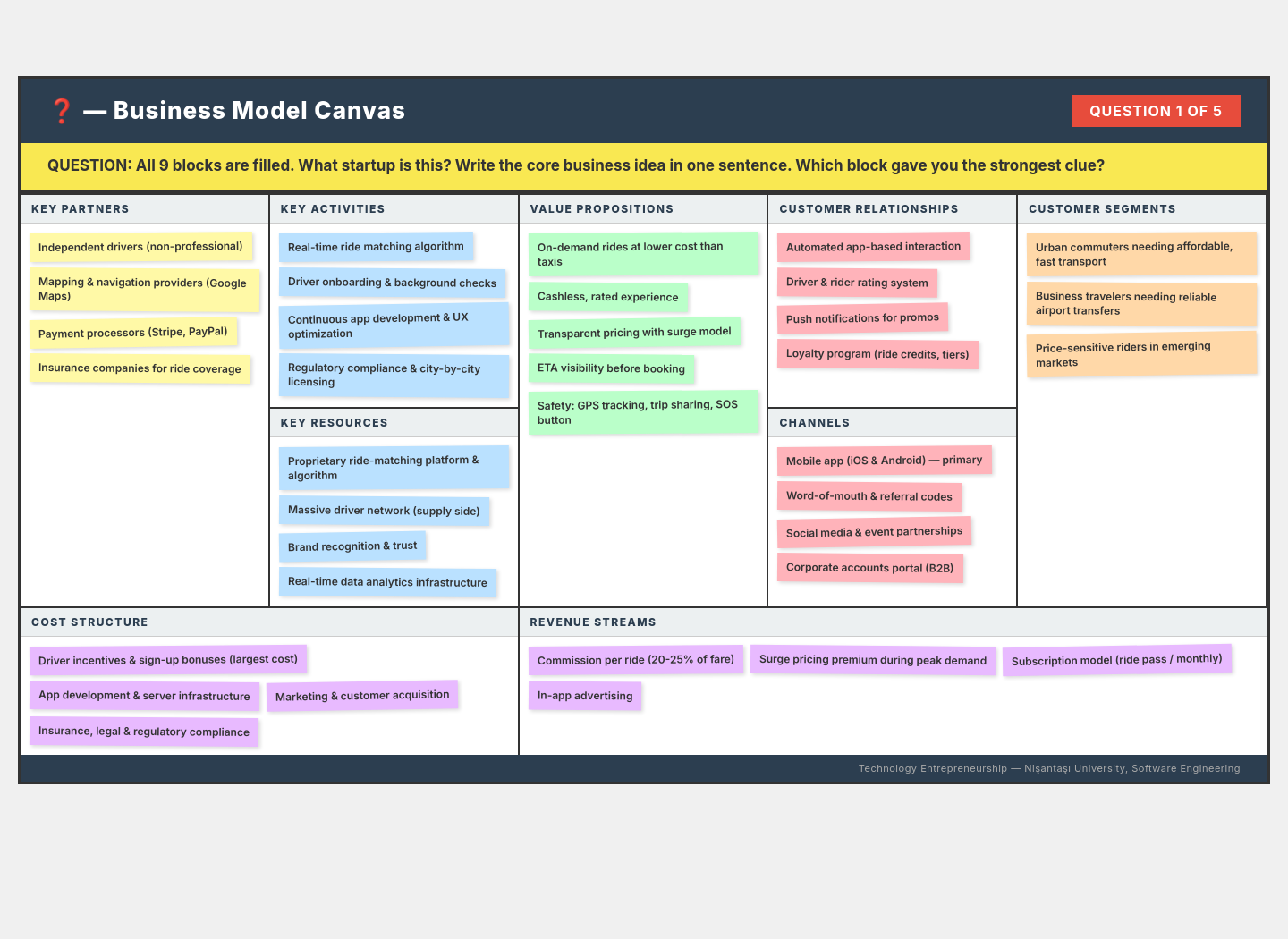
The task: All 9 boxes are filled. Name the startup. Write its main idea in one sentence. Which box gave the biggest clue?
Main idea in one sentence: An app that connects riders with nearby drivers for fast, cashless rides, cheaper than normal taxis.
Biggest clue: The "Key Activities" box — "real-time ride matching" and "driver background checks" point to a ride app. The "surge pricing" in Value Propositions confirms it. No other big app mixes non-professional drivers with real-time matching and surge pricing.
Question 2 — Which Startup + What Is The Money Risk? (Spotify)
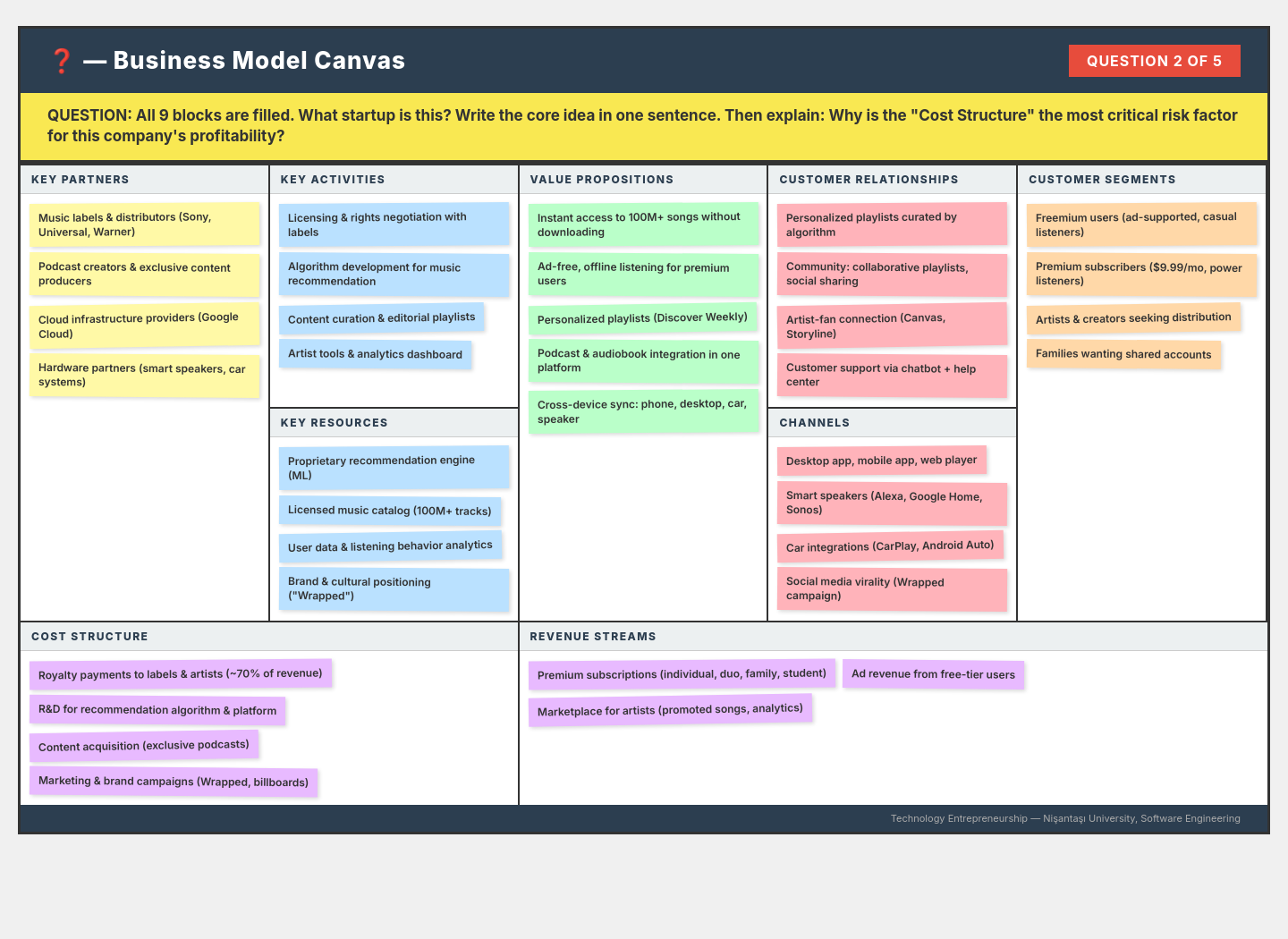
The task: Name the startup. Explain why its Cost Structure (what it spends) is the biggest risk.
Main idea: A freemium app giving instant access to 100M+ songs, with paid ad-free plans as the main money-maker.
Why Cost Structure is the biggest risk: Payments to music labels and artists eat about 70% of all money Spotify makes. So margins are tiny — no matter how many users join, most of every dollar goes to the music owners. Worse, three big labels (Sony, Universal, Warner) control most music. If one pulls its songs, Spotify loses a big part of its value overnight. This is why Spotify struggles to make a steady profit, even with 600M+ users.
Question 3 — Fill In The Missing Boxes (FreshBox)
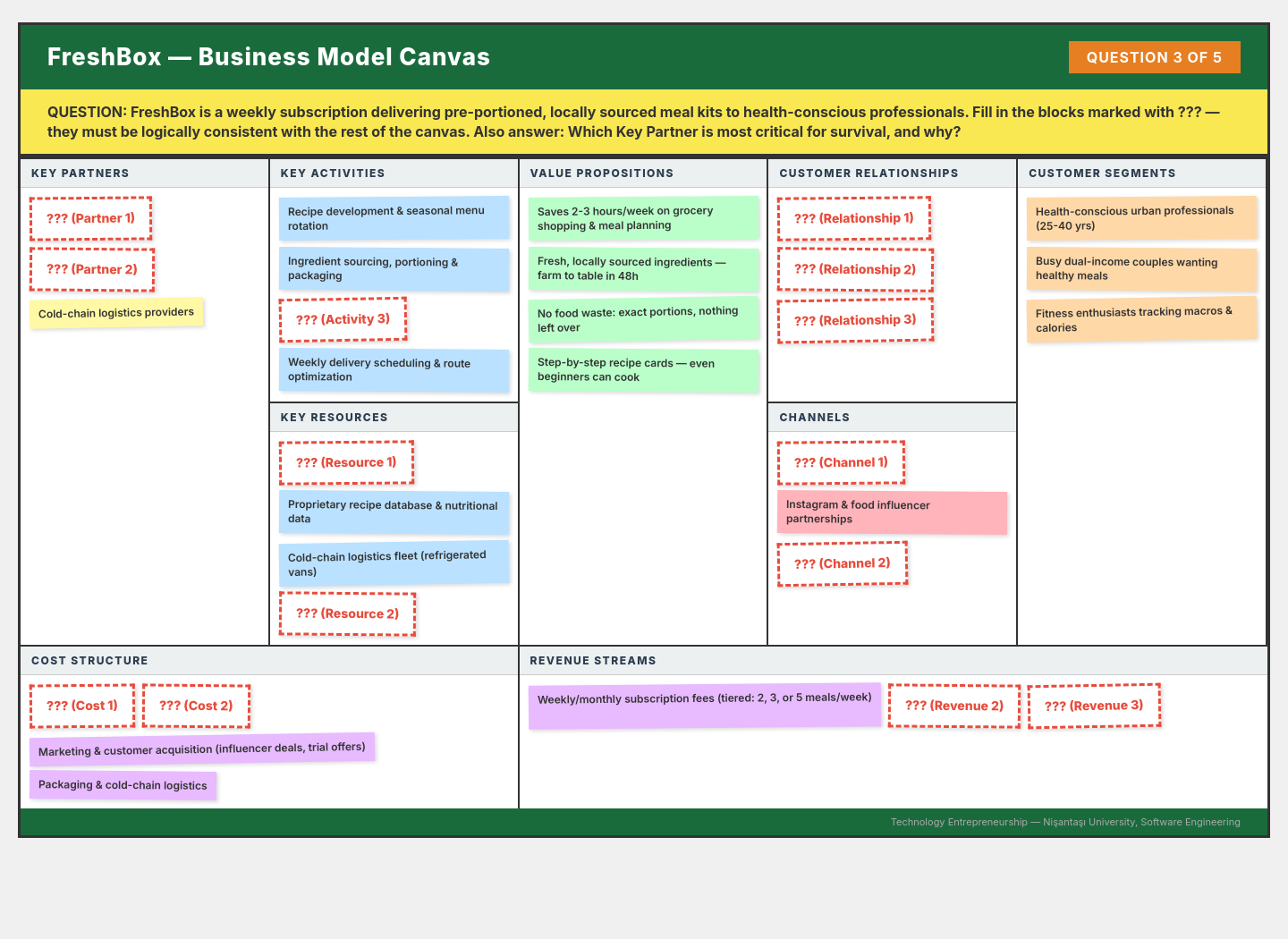
The task: FreshBox sends weekly boxes of fresh, local meal-kits to busy, health-minded people. Some boxes are empty. Fill them in. Then name the most important partner, and explain a switch to selling to businesses (B2B).
Key Activity: quality control & food safety checks.
Customer Relationships: weekly menu tips by app/email; easy subscription (pause, skip, swap); feedback loop (rate recipes).
Key Resources: strong farm relationships (supply network); the subscription app/website.
Channels: website & app (main ordering); referral program ("give a box, get a box").
Costs: buying fresh food from farms (biggest cost); kitchen/warehouse work.
Revenue: premium add-ons (extra protein, desserts); gift boxes for holidays.
Most important partner: the local farms. Without a steady supply of fresh, local food, FreshBox can't keep its main promise ("farm to table in 48 hours"). Packaging or delivery partners are easy to swap, but trusted farm relationships take months to build and directly affect the product.
To sell to businesses (B2B), change these boxes: add "office managers ordering team lunches" to Customer Segments; add a B2B sales team and a company ordering portal to Channels; change the Value Proposition to "team lunches with diet options at scale"; add company contracts with volume pricing to Revenue.
Question 4 — Find The 3 Broken Boxes (ParkSpot)
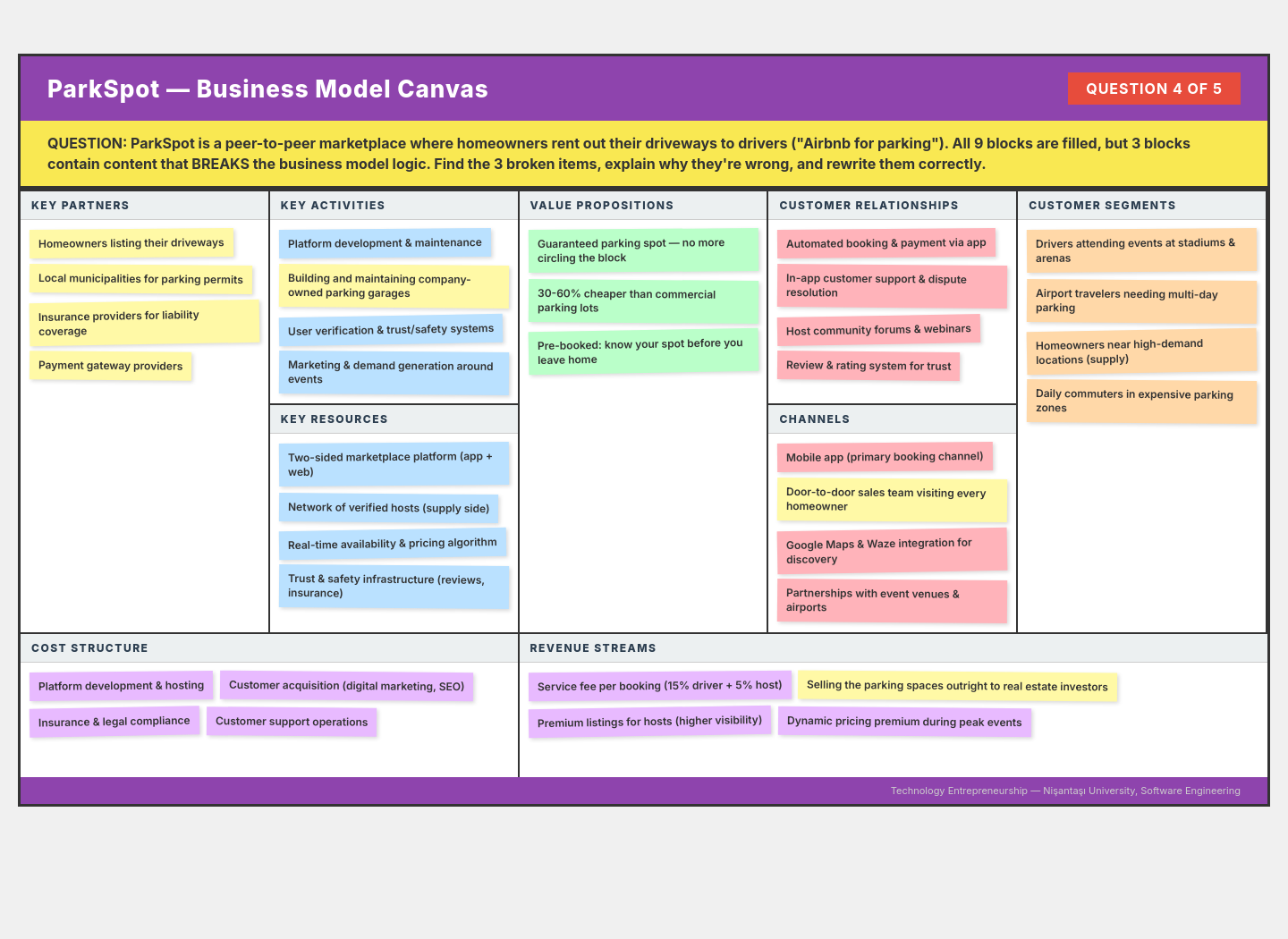
The task: ParkSpot lets homeowners rent out their driveways to drivers ("Airbnb for parking"). Three boxes have content that breaks the model. Find them, say why, and fix them.
Why it's wrong: ParkSpot is a marketplace that connects people. It owns nothing. Building garages would make it a normal parking company, kill its ability to grow cheaply, and cost huge money.
Fix: "Matching supply with demand — helping hosts list spaces for busy event days."
Broken 2 — Channels: "Door-to-door sales team visiting every homeowner."
Why it's wrong: An online marketplace grows through digital channels and referrals, not slow, costly door-knocking.
Fix: "SEO and local ads for 'cheap parking near [stadium/airport]'."
Broken 3 — Revenue Streams: "Selling the parking spaces to real estate investors."
Why it's wrong: ParkSpot does not own the spaces — homeowners do. You can't sell what you don't own. The real money is a commission (a % cut) from each booking.
Fix: "A 15–20% service fee on each parking booking."
Question 5 — Find The 3 Broken Boxes (LangBuddy)
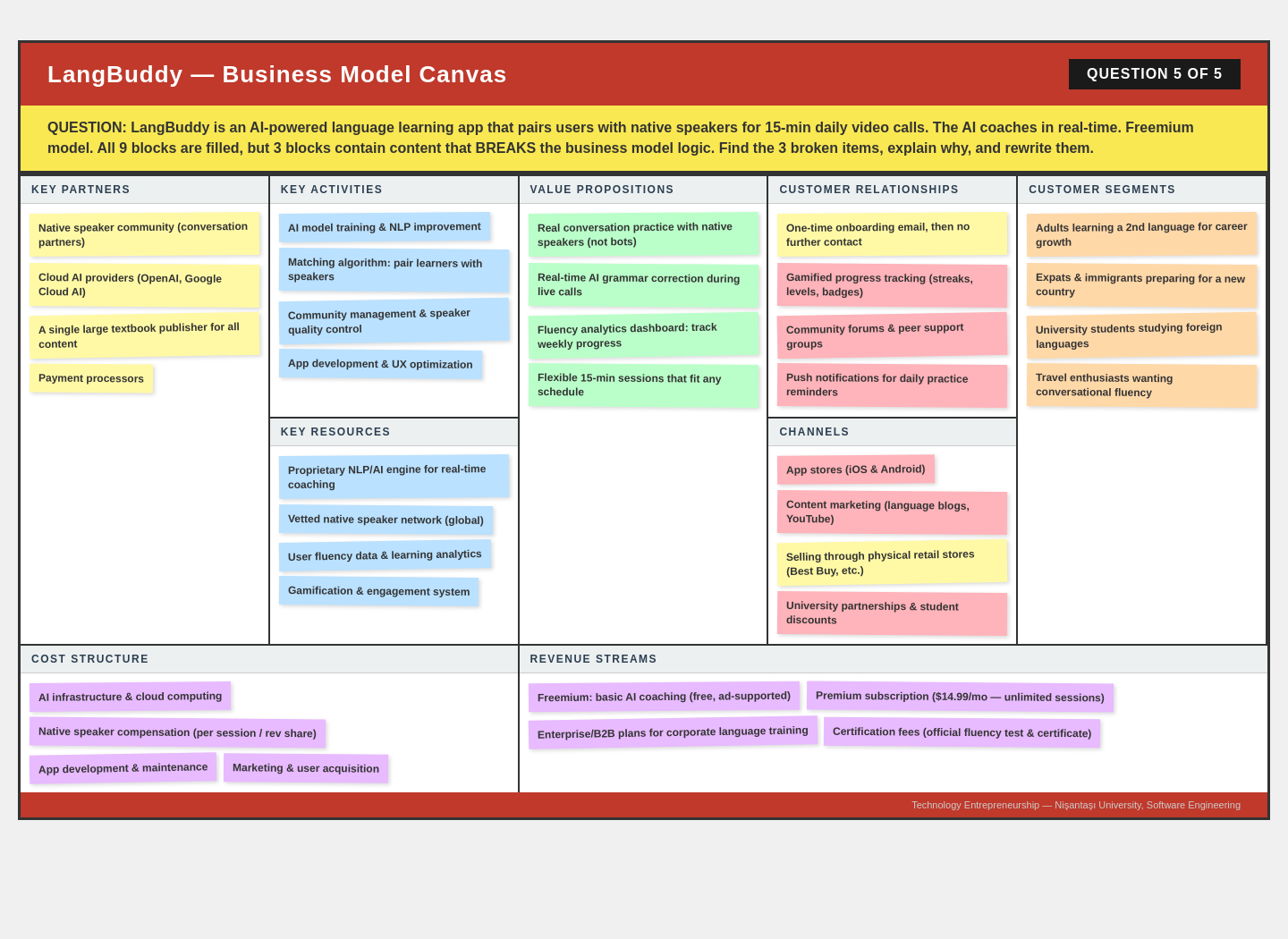
The task: LangBuddy is an app that pairs users with native speakers for 15-minute daily video calls, with AI coaching. It's freemium. Three boxes break the model. Find them, say why, and fix them.
Why it's wrong: LangBuddy is about live talking and AI coaching, not textbooks. A static textbook is the opposite of what makes it special.
Fix: "Speech and language AI providers (like Deepgram) for real-time pronunciation help."
Broken 2 — Customer Relationships: "One onboarding email, then no contact."
Why it's wrong: A freemium app needs daily use, streaks, and habits. With no reminders or re-engagement, users quit in days. This also clashes with the "streaks and badges" in Key Resources.
Fix: "Daily streak reminders, weekly progress reports, and win-back messages for inactive users."
Broken 3 — Channels: "Selling in physical shops (like Best Buy)."
Why it's wrong: It's a free app from the app store. You don't buy a free app in a shop. This channel is costly and pointless here.
Fix: "App store optimization + TikTok/YouTube creators showing live AI coaching."
The Whole Course, Connected
Numbers — And The Decision Each One Drives
| Signal | What it really tells you |
|---|---|
| ~40% "very disappointed" | Enough people now depend on the product — that's what "fit" feels like. Below it, keep improving; don't grow yet. The exact number matters less than the idea: do people truly need this? |
| LTV bigger than CAC (≈3×) | You earn more from a customer than you spent to get them — so growth makes money instead of losing it. If LTV is below CAC, every new customer makes you poorer. This is the heart of whether a business works. |
| High monthly churn (~5%+) | People are leaving as fast as they arrive — a leaking bucket. Adding more customers won't help until you fix why they leave. Churn quietly decides if you live or die. |
| Runway getting short (~6 months) | You're running low on time, and raising money itself takes months — so act early. Runway is really a clock measuring your freedom to make calm decisions. |
| More steps = more people lost | Every extra step in a flow drops a chunk of users. Shorter paths keep more people. The lesson isn't a percentage — it's "remove every step you can." |
| ~5 test users | You don't need a big expensive study to find most design problems — a few real users reveal them fast. So testing is cheap; there's no excuse to skip it. |
| Fixing UX late costs far more | A problem caught on paper is cheap; the same problem caught after launch is expensive to undo. So test before you build, not after. |
| Dilution multiplies (e.g. 0.8 × 0.8) | Each funding round shrinks your slice, and the rounds stack on each other. But a smaller slice of a big pie beats all of nothing. Understand the trade, don't fear the number. |
| Most VC bets fail; a few pay for all | Why VCs only want companies that could become huge — and why VC money is wrong for a calm, steady business. It explains how investors think, so you can tell if they fit you. |
| "Be much better, not a little better" | People don't switch for a tiny improvement — the hassle isn't worth it. You need to be clearly, obviously better. This is why "10× better" beats "10% better." |
| Most startups fail from no market need | The single most common cause of death is building something nobody wanted. This one fact is the reason the whole course exists. |
The Tools — And What Each One Is Actually For
The Idea That Ties Everything Together
Almost every startup dies for one reason: it built something nobody wanted. Now look back at every tool in this course — talking to customers, the MVP, prototypes, the 40% test, market sizing, the pitch. Each one is just a different way of answering the same question early: "do people actually want this, and will they pay?" That's the whole subject. Understand that, and the details are no longer things to memorize — they're things that simply make sense.— Why everything in this course exists.
If You Want To Go Deeper (Optional)
- The Lean Startup — Eric Ries · the build-measure-learn idea in full
- The Startup Owner's Manual — Steve Blank · the complete customer-development guide
- Business Model Generation — Alexander Osterwalder · from the people who created the Canvas
- The Mom Test — Rob Fitzpatrick · how to talk to customers honestly
- Traction — Gabriel Weinberg · how startups actually find customers
- Zero to One — Peter Thiel · the thinking behind building something genuinely new
More Scenario Questions — Solve Like The Real Exam
HOW TO USE THIS SECTION: Open a question. Read the company data. Solve it on paper first — really write your answer. Then press "Reveal Answer" to compare. If you got it wrong, go back and re-read that week.
Part A — Product & Market Fit (Week 6)
Q1 · CloudNote's survey — does it have Product-Market Fit?
The data: CloudNote, a note-taking app, asked 200 users: "How would you feel if you could no longer use CloudNote?"
- 70 users said "very disappointed"
- 80 users said "somewhat disappointed"
- 50 users said "not disappointed"
Your task: Does CloudNote have Product-Market Fit? Show the math. What should the founders do next — grow, raise money, or something else?
Step 2 — The math: 70 ÷ 200 = 35%. That is BELOW 40%.
Step 3 — The answer: No, CloudNote does NOT have Product-Market Fit yet. The rule: below 40% → do not scale, do not raise money. Instead: go back to customer interviews. Study the 70 users who said "very disappointed" — what do they love? What is similar about them? Narrow the product to serve that group better, then test again.
Q2 · Choose the right MVP — the AI meal-planner idea
The situation: A founder has an idea: an AI app that plans your weekly meals automatically. She has: no code yet, 2 weeks of time, and almost $0 budget. She wants to know if people would use and pay for this before building the AI (the AI alone would take 6 months to build).
Your task: Which MVP type(s) should she use, and why? What should she NOT do?
▸ Landing page MVP — a simple web page describing the app, with a "join the waitlist / pre-order" button. Tests demand in days for ~$0.
▸ Wizard of Oz MVP — users think the AI plans their meals, but the founder writes each plan by hand behind the scenes. This tests if people will actually USE and PAY, without building any AI.
▸ Concierge MVP — she openly plans meals for 5–10 people personally, to deeply learn what they need.
What NOT to do: Spend 6 months building the AI first. That breaks the MVP rule (build the smallest thing to learn the most) and risks the #1 failure: building something nobody wants. Remember: if an MVP takes more than 4 weeks, it is too big.
Q3 · Sort the features — MoSCoW for a delivery app MVP
The data: A team is building the first version of a food delivery app. Their feature wish-list: (a) user login, (b) dark mode, (c) restaurant list + ordering, (d) support for 6 languages, (e) password reset by email, (f) live driver tracking on a map.
Your task: Sort these into MoSCoW groups (Must / Should / Could / Won't) for the FIRST version, and explain your logic in one sentence each.
Should have: (e) password reset, and arguably (f) live tracking — important, but version 1 can launch without them (tracking can be a simple "order status" text first).
Could have: (b) dark mode — nice, changes nothing about the core job.
Won't have (this version): (d) 6 languages — written down on purpose for later.
Accept small differences (e.g., tracking as "Must" for a delivery app is defendable) — what matters is that you EXPLAIN the logic. The real lesson: the power of MoSCoW is the "Won't" group — saying no on purpose keeps the MVP small.
Q4 · Read the signals — should StudyPal scale now?
The data: StudyPal, a study-planner app, shows these numbers after 6 months:
- 45% of new users come from friends telling friends (referrals), not ads
- The retention curve drops at first, then becomes flat — a steady group keeps returning every month
- When the servers went down for 2 hours, support got 300 angry messages
- Two copycat apps appeared last month
Your task: What do these four signals mean together? What should StudyPal do now?
What to do: StudyPal HAS Product-Market Fit — now is the right time to scale: invest in growth channels, consider raising money, and hire. (Before PMF, scaling is the #1 killer. After PMF, NOT scaling lets the copycats win.)
Part B — Prototyping & UX (Week 7)
Q5 · The Figma mistake — match the prototype to confidence
The situation: A team has a brand-new app concept. They say they are about 25% sure it's the right direction. Their plan: spend 3 weeks making a pixel-perfect, clickable Figma prototype with full colors and real photos, then show it to users.
Your task: Is this the right plan? If not, what should they do instead, and why?
Why: (1) Nobody feels sad throwing away a sketch — easy to restart from feedback. (2) A beautiful prototype makes users comment on colors instead of the core idea, and they hold back big criticism because it "looks finished." (3) 3 weeks of polish on an unproven idea is the "prototype as product" anti-pattern.
Correct path: paper sketches with 5 users → grey wireframes when ~50% sure → high-detail Figma only at 70–90% confidence, just before coding.
Q6 · UX audit — why do FitTrack's users quit?
The data: FitTrack, a fitness app, has these problems:
- From download to first workout takes 8 steps
- New users must watch a 3-minute tutorial to understand the app
- Support gets many "how do I start a workout?" questions
- Most users sign up but never finish their first workout
Your task: Diagnose the problems using Week 7 rules, estimate the user loss, and give the fixes.
▸ 8 steps is too many. Rule: each extra step loses ~20% of users; keep the main path ≤ 5 steps. With 8 steps, roughly 0.8⁸ ≈ only 17% of users survive to the end — about 83% are lost on the way.
▸ Needing a tutorial = broken UX ("Don't Make Me Think"). A new user should finish the core task in under 60 seconds with no help.
▸ "How do I..." tickets and dead signups = UX debt. Fixing this after launch costs 10× more than fixing it in prototypes.
Fixes: cut the path to ≤5 steps (ideally 3); make "start a workout" the one big obvious button on the first screen (one-screen test); remove the tutorial by making the design self-explaining; test the new flow with just 5 users (they will find 85% of the problems).
Part C — Selling & Money (Weeks 8–9) — the biggest part
Q7 · SaaSCo's unit economics — CAC, LTV, and the ratio
The data: SaaSCo spends $30,000 per month on marketing and sales. This brings 60 new customers per month. Each customer pays $50/month (ARPU). Monthly churn is 2.5%.
Your task: Calculate CAC, LTV, and the LTV:CAC ratio. Is this business healthy? What would you advise?
LTV = ARPU ÷ churn = $50 ÷ 0.025 = $2,000.
LTV : CAC = 2,000 : 500 = 4 : 1.
Verdict: Healthy — above the golden 3:1 rule. Each customer brings back 4× what they cost. Advice: this engine works; SaaSCo can safely spend more on growth (a very high ratio like 5:1+ would even mean they are being too careful).
Q8 · Burn and runway — when should DataPilot start fundraising?
The data: DataPilot has $600,000 in the bank. Total expenses are $55,000/month. Revenue is $15,000/month.
Your task: Calculate the net burn rate and the runway. Is DataPilot in danger? When should they start raising the next round?
Runway = cash ÷ net burn = $600,000 ÷ $40,000 = 15 months.
Verdict: Not in danger today — 15 months is comfortable (investors like 12–18). But raising a round takes 3–6 months, so DataPilot should start preparing now and begin actively raising within ~6 months, so they never fall below the danger line of 6 months runway. Raising while desperate destroys your negotiating power.
Q9 · Break-even — how many customers does TutorHub need?
The data: TutorHub's fixed costs are $20,000/month (salaries + rent). It charges $45 per user per month. Serving each user costs $5/month (servers, payment fees).
Your task: Calculate the break-even number of customers. Show every step.
Step 2 — break-even = fixed costs ÷ money kept = $20,000 ÷ $40 = 500 customers.
At 500 paying customers, money in = money out. Customer 501 starts the profit. Every founder should know this number by heart — it turns a fuzzy goal into a clear sales target.
Q10 · The leaky bucket — why is GrowFast stuck at 1,000 customers?
The data: GrowFast adds 100 new customers every month from paid ads. But its total customer count has been stuck at exactly 1,000 for six months. The marketing team asks for a bigger ad budget.
Your task: What is really happening? Calculate the churn rate. Should they increase the ad budget?
Churn rate = 100 leavers ÷ 1,000 customers = 10% per month — that's a death spiral (≈72% of customers lost per year).
Advice: NO — do not increase the ad budget. The rule: if monthly churn is above 5%, stop spending on marketing and fix the product first. Pouring more water into a leaky bucket just wastes money. Find why people leave (interviews with churned users), fix it, then grow.
Q11 · Wrong sales motion — the $15/month tool with a sales team
The situation: A student team built a $15/month design tool for freelance designers. Their plan: hire two salespeople to book meetings and close deals one by one, like big enterprise companies do.
Your task: Is this the right go-to-market motion? Explain using the sales-led vs. product-led comparison.
The right motion: product-led growth (PLG). Cheap product + individual buyer = let the product sell itself: a free tier, fast value in minutes, then upgrade. Like Slack, Figma, Notion. Worth understanding: most student startups should start product-led — your product IS your sales team.
Q12 · Build a bottom-up forecast — month 1 for LingoKids
The data: LingoKids will spend $2,000 on ads in month 1. Each click costs $2. Of all visitors, 2.5% become paying users. The price is $40/month.
Your task: Build the month-1 forecast bottom-up: visitors → paying users → MRR. Also calculate the CAC. Why do investors prefer this style over "the market is $50B, we'll take 1%"?
Paying users = 1,000 × 2.5% = 25 customers.
MRR = 25 × $40 = $1,000/month.
CAC = $2,000 ÷ 25 = $80 per customer.
Why bottom-up wins: "$50B market × 1%" is lazy top-down guessing — investors don't trust it. Bottom-up starts from YOUR real budget and real conversion rates, so it proves you understand how your business machine actually works. Investors know the final numbers will be wrong; they are checking if you know how the numbers CONNECT.
Q13 · NRR — is MetricFlow growing without new customers?
The data: MetricFlow starts the month with $100,000 MRR from existing customers. During the month: upgrades add $15,000 (expansion), downgrades remove $5,000 (contraction), and cancellations remove $8,000 (churn).
Your task: Calculate NRR. What does the number tell you about the product?
= (100,000 + 15,000 − 5,000 − 8,000) ÷ 100,000 = 102,000 ÷ 100,000 = 102%.
Meaning: Above 100% = the "leak" is smaller than the upgrades — MetricFlow grows even with ZERO new customers. 100–110% is good standard SaaS; 120%+ is elite. NRR over 100% is one of the strongest signs of true Product-Market Fit: customers love it so much they pay MORE over time.
Q14 · Pick one channel — the Bullseye decision for VetCare
The situation: VetCare makes booking software for animal clinics in Türkiye. The founders are trying SEO, Google Ads, Instagram, email, TikTok, and cold calls — all at the same time, each a little bit. Nothing is working well.
Your task: What is the mistake? Apply the Bullseye Framework and suggest which channel logic fits this ICP.
Bullseye fix: (1) Brainstorm an idea for all 19 channels → (2) cheaply TEST the top 6 for a few weeks with clear numbers → (3) FOCUS everything on the 1–2 winners, ignore the rest.
Channel logic for this ICP: vet clinics are a specific niche searching for solutions — long-tail SEO ("booking software for veterinary clinics in Türkiye") plus targeted demos/partnerships where vets already are (vet associations, supplier networks). Generic TikTok ads target everyone = reach no one.
Part D — Funding & Team (Weeks 10–11)
Q15 · Cap table math — what do the founders own after two rounds?
The data: Two founders start 50/50 (100%). At Seed, investors take 20% and a 10% option pool is created. At Series A, new investors take another 20% (everyone existing is diluted equally).
Your task: What percent does EACH founder own after the Seed? After the Series A? Is this dilution bad?
After Series A: everyone shrinks by 20% (multiply by 0.8): 35% × 0.8 = 28% each (founders together: 56%).
Is it bad? No — this is normal and healthy. Key idea: dilution multiplies (0.8 × 0.8), it doesn't simply add. And owning 28% of a company worth $50M is far better than owning 50% of a company worth nothing. The pie gets smaller per slice, but the whole pie gets much bigger.
Q16 · The vesting cliff — two co-founders quit
The data: A startup gave each of two early co-founders 30% equity on the standard plan: 4-year vesting with a 1-year cliff. Co-founder A quits at month 10. Co-founder B quits at month 24.
Your task: How much equity does each one keep? Why does this system exist?
Co-founder B (month 24): 24 months = half of 4 years = 50% vested → keeps 50% × 30% = 15% of the company. The other 15% returns.
Why it exists: vesting protects the company from someone leaving early with a huge piece of it. Equity must be EARNED over time. Investors demand all founders vest — refusing to vest is a giant red flag.
Q17 · Which money? — a profitable, steady B2B company
The situation: InvoiceTR makes invoicing software for Turkish freelancers. It is already profitable, grows a steady 5% per month, and the founders want to keep control and build a healthy company — they do not dream of being a billion-dollar giant. A VC offers them $2M for 25%.
Your task: Should they take the VC money? What funding fits them better, and why? Use the VC power-law logic.
Better fits: Bootstrapping (keep 100%, grow from revenue — the Mailchimp path: no outside money, sold for $12B) or revenue-based financing (cash now, repaid as a % of revenue, no equity lost). Key exam line: capital is a tool, not a goal — match the money to the business.
Q18 · Two term sheets — high price vs. fair terms
The data: A startup receives two offers:
- Investor A: $20M valuation, BUT with a 2× participating liquidation preference and full-ratchet anti-dilution.
- Investor B: $15M valuation, with the standard 1× non-participating preference and weighted-average anti-dilution.
Your task: Which offer should the founders take, and why? What do these scary words mean in simple language?
Simple translations:
▸ 1× non-participating (fair, standard): when the company is sold, the investor takes their money back OR their share — whichever is bigger, not both.
▸ 2× participating (toxic): the investor takes DOUBLE their money first, AND THEN also their share of what's left — double-dipping. In many sale scenarios, founders get almost nothing.
▸ Full ratchet (toxic): if a future round has a lower price, the early investor's shares get repriced fully against you, crushing founders.
The exam lesson: founders obsess over the headline valuation and ignore control/economic terms. A lower price with fair terms beats a high price with toxic terms. Control > valuation. Also remember: after signing, the "no-shop" clause freezes you — negotiate BEFORE signing.
Q19 · SAFE math — what does the angel's $100K become?
The data: An angel invests $100,000 on a SAFE with a $5M valuation cap. One year later, VCs invest in the Series A at a $10M valuation.
Your task: At what valuation does the angel's money convert into shares? Why is that fair? And what is the key difference between a SAFE and a convertible note?
Why fair: the angel took the risk earliest, when the company was just an idea. The cap rewards that early risk.
SAFE vs. convertible note: a SAFE (by Y Combinator) is NOT a loan — no interest, no repayment deadline; it simply becomes shares at the next round. A convertible note IS a loan — it carries interest and a maturity date and must be repaid if it never converts. Today nearly all early deals use SAFEs (founder-friendly).
Q20 · The brilliant jerk — hire or pass?
The situation: A 6-person startup interviews an engineer. His test project is the best they have ever seen — clearly top 1% skill. But both reference calls say the same thing: "brilliant, but he humiliates teammates and ignores everyone's ideas."
Your task: Hire or not? Use the skill/attitude matrix. What is the long-term cost of the wrong choice? And what does "hire slow, fire fast" mean here?
The matrix: Star (high skill + good attitude) → hire and give freedom. Potential (low skill + good attitude) → train. Toxic Genius → never. Pass (low/low) → easy no.
"Hire slow, fire fast": take real time to verify attitude before hiring (structured interviews + paid trial project); and if someone is already harming the team, act quickly and kindly — the Netflix Keeper Test: "would I fight to keep them?" If no, let them go.
Part E — The Pitch (Week 12)
Q21 · Fix this problem slide — "marketing is inefficient"
The data: A founder's first pitch slide says only: "Marketing is inefficient for companies." Investors look bored.
Your task: Why is this slide weak? Rewrite it using the three rules of a strong problem statement (specific, urgent, human). Invent realistic numbers.
A strong rewrite (example):
▸ Specific: "Marketing managers waste 14 hours every week hand-formatting Excel reports."
▸ Urgent: "Teams are cutting budgets — they must prove results NOW or lose their spend."
▸ Human: "Meet Ayşe, a CMO in Istanbul. Every Sunday night she copies numbers between 3 tools instead of seeing her family."
▸ Scale: "This exact workflow burns $12B per year across 4 million businesses."
One slide, ONE pain — hit the worst one hard.
Q22 · Pitch teardown — find every mistake in this opening
The data: A founder starts their investor pitch like this: "Hi everyone, I'm Mert, CEO of DataX. Sorry we started late, and sorry if the demo breaks — it was working five minutes ago! So, um, let me walk you through our 35 slides… (reads slide 1 aloud word-for-word, speaking very fast)"
Your task: List every mistake and say what he should have done instead.
1. Wasted the 30-second window on name + title — investors decide in the first 30 seconds; open with a hook (a question, a shocking number, a 20-second customer story, or a bold claim).
2. Apologized twice — apologizing lowers your status before you begin.
3. "It was working five minutes ago" — never say this; have a backup video ready and switch silently.
4. 35 slides — breaks 10/20/30 (max 10 slides, 20 minutes, min 30-pt font).
5. Filler words ("um") — replace with silence; a pause looks confident.
6. Reading slides word-for-word — the audience reads faster than you talk, then stops listening. You are the presentation; slides are the backdrop.
7. Speaking too fast — rushing signals fear; speak ~20% slower, vary speed and volume.
Q23 · Build the story — RoboFarm's pitch has no shape
The situation: RoboFarm (crop-monitoring drones for small farmers) opens its pitch with a feature list: camera resolution, flight time, AI accuracy. Investors stay cold.
Your task: Rebuild the pitch as a 3-act story. Who is the hero? Who or what is the villain? Where do the three brain chemicals fire?
Act 1 — the problem (fires cortisol = focus): "Mehmet farms 40 hectares. Last summer a fungus destroyed a third of his crop — he found it two weeks too late, walking his fields on foot." The villain = the status quo: checking huge fields by eye.
Act 2 — failed fixes (builds tension): satellites are too low-detail; agronomist visits are rare and costly; hope is not a strategy. (Skipping Act 2 turns a pitch into a feature list — exactly RoboFarm's mistake.)
Act 3 — the solution (fires dopamine = joy): the drone is the hero's tool: scans 40 hectares in 20 minutes, flags sick plants 10 days before the human eye sees them. Show the before/after delta: 2 weeks late → 10 days early.
The human story of Mehmet fires oxytocin (care/trust). Order matters: tension first, joy after — joy alone feels like a scam. You are Yoda; Mehmet is Luke.
Part F — The Foundations (Weeks 1–5, lighter)
Q24 · Size the market bottom-up — DentSoft in Türkiye
The data: DentSoft makes booking software for dental clinics, priced at $1,200 per clinic per year. There are 30,000 dental clinics worldwide. 5,000 of them are in Türkiye (DentSoft's product is in Turkish only, for now). The team believes it can realistically win 8% of Turkish clinics in its first 2–3 years.
Your task: Calculate TAM, SAM, and SOM in money. Which number matters most to a smart investor, and why?
SAM (reachable now: Turkish-language product) = 5,000 × $1,200 = $6M/year.
SOM (realistic 2–3 year win) = 5,000 × 8% = 400 clinics × $1,200 = $480K/year.
The most important number is SOM — it proves you understand your real limits: your team, money, and channels. Quoting only the big TAM ("if we just get 1%...") is the lazy top-down fallacy that destroys credibility.
Q25 · Fix the interview — three bad Mom Test questions
The data: A founder testing a budgeting app asks people: (a) "Would you pay $10/month for my budgeting app?" (b) "Don't you think tracking expenses automatically is a great idea?" (c) "Do you usually go over budget?"
Your task: Say what's wrong with each question and rewrite all three so even your mom couldn't lie to you.
(b) A compliment-fishing leading question — it pitches your idea and begs for praise. Rewrite: "Walk me through the last time you tried to track your spending. What did you do? What was annoying?"
(c) Vague generality ("usually") — invites fluff. Rewrite: "Tell me about the last month you went over budget. What happened? What did you try afterward?"
The three rules behind every fix: talk about THEIR life (not your idea) · ask about the PAST (not the future) · talk less, listen more. Bonus check: if they never even Googled for a solution, the pain isn't real.
Q26 · Pivot or persevere? — PhotoShare's surprising data
The data: PhotoShare built a full social network for photographers: profiles, feeds, groups, messaging, photo filters. After 4 months, the data shows: 90% of activity uses ONLY the photo-filter tool. Feeds and groups are nearly dead. Users open the app, apply a filter, save the photo, and leave.
Your task: What should PhotoShare do, and what is this move called? Is it failure?
Is it failure? No — a pivot is a planned change of direction based on real evidence, keeping the big dream. 93% of successful startups ended with a different plan than they started with. The data already paid for itself: PhotoShare LEARNED what people want. Ignoring that data and pushing the social network would be the real failure (refusing to pivot when all the data says you should).